

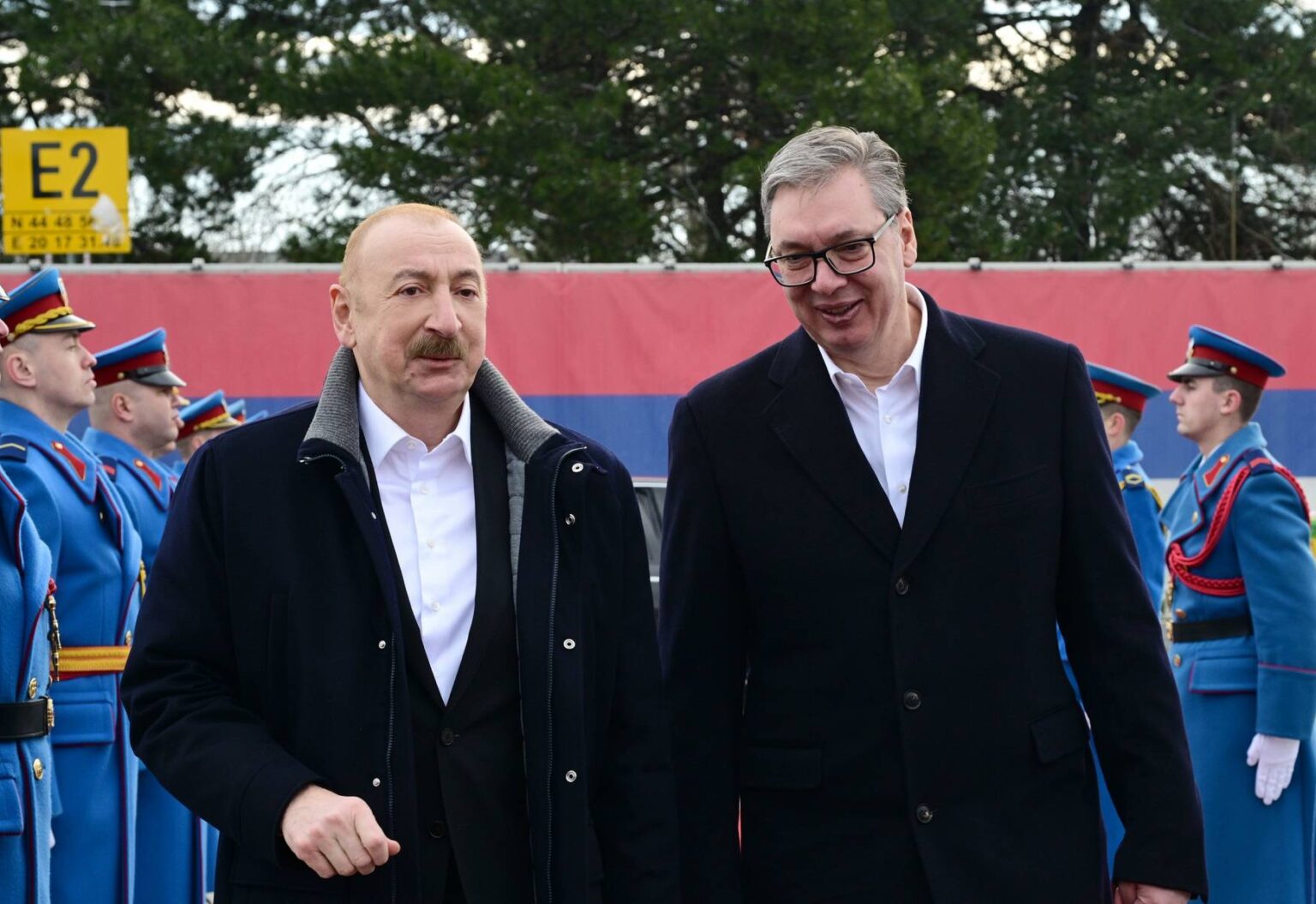
The recent visit of Azerbaijan’s president to Belgrade on Serbia’s Statehood Day reflects more than ceremonial diplomacy; it signals the gradual consolidation of a strategic partnership that is acquiring institutional depth, economic substance, and geopolitical relevance. The symbolism of the timing underscored the level of political trust between the two countries, while the launch of a Strategic Partnership Council elevated bilateral relations into a structured, long-term framework designed to outlast political cycles.
Over the past decade, cooperation between Baku and Belgrade has evolved from pragmatic dialogue into a multidimensional partnership built on shared interests and mutual political sensitivity. Both states place particular emphasis on sovereignty and territorial integrity, issues that have shaped their foreign policy outlook and contributed to a stable political understanding. This alignment has allowed the relationship to develop without the ideological friction that often complicates partnerships in the Balkan and South Caucasus regions.
Institutionalisation now appears to be the central priority. The Strategic Partnership Council format introduces regular coordination mechanisms, concrete roadmaps, and administrative accountability, transforming high-level political goodwill into a system capable of delivering practical outcomes. In this sense, the visit marked a transition from symbolic friendship toward a policy-driven partnership anchored in infrastructure, energy, and investment cooperation.
Energy remains the cornerstone of the emerging agenda. Serbia’s geographic and structural vulnerabilities — including its landlocked position and historical dependence on Russian supplies — have increased the urgency of diversification as the European energy market undergoes rapid transformation. Azerbaijan, having strengthened its role as a gas supplier to Europe, is expanding its presence into Southeast Europe, where demand for alternative sources continues to grow.
Potential gas deliveries through regional interconnectors represent one dimension of this shift, but the cooperation is moving beyond simple supply contracts. Discussions around joint energy infrastructure projects, including the construction of a gas-fired power plant, suggest a deeper model based on shared investments and technological transfer. Such initiatives would not only provide Serbia with greater energy resilience but also allow Azerbaijan to expand its role from exporter to integrated energy investor, creating additional value chains across the Balkans.
The involvement of Azerbaijan’s state energy company in European markets reflects a broader strategic evolution. Rather than limiting itself to upstream resource exports, the company aims to establish a vertically integrated presence encompassing infrastructure, generation, and downstream activities. Previous international projects — including gasification initiatives and large-scale energy investments abroad — demonstrate a model that combines economic pragmatism with geopolitical positioning. Serbia’s market, with its demand for modernization and infrastructure renewal, offers a testing ground for further expansion.
At the same time, economic cooperation is diversifying beyond hydrocarbons. Growth in the services sector — particularly transport, tourism, and logistics — highlights a gradual shift toward connectivity-based development. The planned launch of direct flights between Baku and Belgrade is a small but significant infrastructural step that reduces logistical barriers and accelerates business exchanges, cultural contacts, and tourism flows. Such projects often function as catalysts, strengthening networks that underpin long-term political cooperation.
Investment cooperation is also gaining momentum. Azerbaijan has historically shown interest in infrastructure development across partner countries, ranging from construction projects to modernization initiatives. For Serbia, attracting diversified external investment aligns with its strategy of balancing European integration with a multi-vector foreign policy that preserves strategic autonomy. For Azerbaijan, expanding into the Balkans complements its broader vision of linking the Caspian region with European markets through energy and transport corridors.
The geopolitical context surrounding this partnership is complex but largely conducive to gradual expansion. Both countries pursue flexible foreign policies, seeking cooperation with multiple centers of power rather than rigid alignment. This pragmatic approach reduces the likelihood of major external backlash. The scale of Azerbaijani–Serbian energy cooperation, while strategically meaningful, remains moderate enough to avoid provoking significant tension with Brussels or Moscow, particularly as European institutions themselves encourage diversification of energy sources.
At the regional level, Azerbaijan’s engagement with Serbia also fits into a wider pattern of growing ties with several Balkan states. The strategy appears to emphasize incremental expansion — building bilateral partnerships that collectively increase Azerbaijan’s presence in Southeast Europe without generating overt geopolitical confrontation. Such a model relies on economic interdependence and infrastructure projects rather than overt political alignment.
The personal rapport between leaders has further accelerated the process, creating an atmosphere of trust that facilitates quicker decision-making and project implementation. In diplomatic practice, such dynamics often serve as catalysts for institutional innovation, allowing ambitious initiatives to move forward despite bureaucratic inertia.
Taken together, these developments suggest that Azerbaijani–Serbian relations are transitioning from a phase of friendly cooperation to one defined by structured strategic alignment. The visit on Statehood Day symbolized not only mutual respect but also a shared intention to anchor the partnership within Europe’s evolving geopolitical landscape. If current trends continue — particularly in energy investment, infrastructure development, and connectivity — the Azerbaijani–Serbian axis could emerge as one of the more stable bilateral formats linking the Balkans with the wider Eurasian space.