


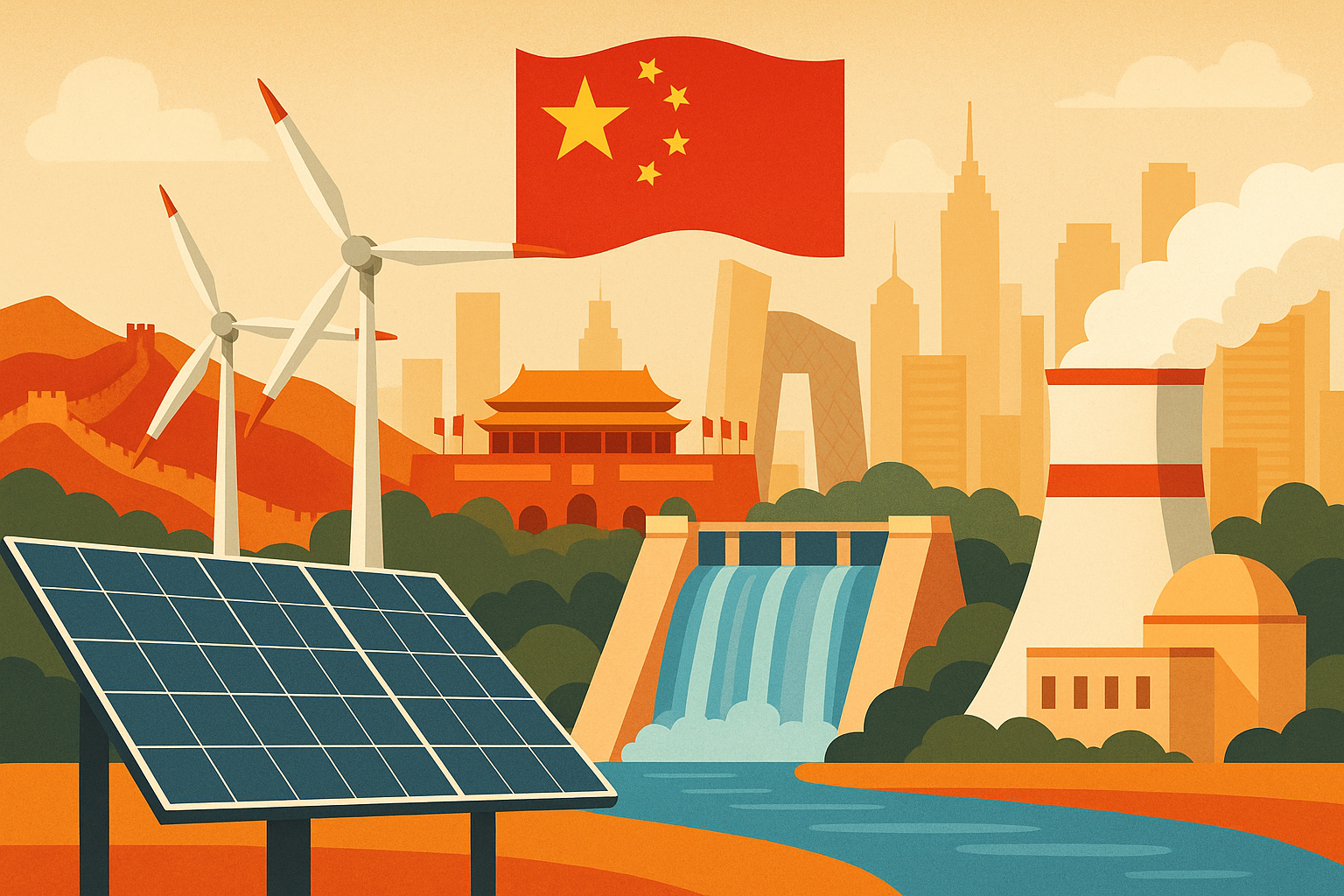
Over the past decade, China has transformed from a country facing large-scale energy deficits into a global leader in electricity production and the export of “green” technologies and generating equipment. This achievement cannot be explained by isolated decisions; it reflects a systemic state policy combining strategic planning, preferential financing mechanisms, institutional support, and a concentration of research efforts. Today, China holds leading positions in all major forms of generation—hydro, solar, wind, and nuclear—and, judging by current dynamics, no other country is prepared in the foreseeable future to catch up in terms of overall scale and pace of capacity growth.
At the same time, “traditional” or conventionally “dirty” generation has not been discarded: coal plants remain a tool for balancing variable renewables, with their environmental performance improving through technological modernization and regulatory oversight. China is building parallel contours of its energy system: rapid expansion of the “green” portfolio while maintaining baseload through coal and nuclear, thereby softening the natural variability of sun and wind and reducing systemic risks during the transition.
In hydropower, the prime example remains the world’s largest operating hydropower plant, the Three Gorges Dam, with plans to surpass it: on the Tibetan Plateau, China is implementing a new hydropower project on the Yarlung Tsangpo River, estimated at $167 billion with an annual output of about 300 billion kWh. Legitimate concerns from neighboring Bangladesh and India about water flows and cross-border impacts are addressed by Beijing with assurances of hydrological, ecological, and geotechnical stability—shifting the debate into the realm of trust in impact assessments and operational transparency.
In solar power, this year alone China installed 93 GW of panels—four times more than in spring last year. Altogether, China accounts for around 35% of global capacity. In solar module exports, it retains dominance: according to Infolink, last year exports reached 235.93 GW (+13% year-on-year), of which European countries imported about 95 GW, with the Netherlands and Spain taking the largest share. Deliveries to the Asia-Pacific grew 26%, led by Pakistan and India; the latter, despite its own production, remains highly dependent on competitively priced high-tech Chinese modules. Chinese panels are also expanding steadily into North and South America, the Middle East, and Africa, underlining the global reach of supply chains and the price elasticity of demand.
A qualitative difference at this stage is the accelerated commercialization of the next technological leap. China launched the world’s first gigawatt-scale factory for perovskite solar panels. Thanks to high optical absorption and charge-carrier mobility, perovskite elements promise higher efficiency at lower cost. At full capacity, the plant will produce about two million large-format modules annually; perovskite is already being integrated into existing facilities, with new production lines under construction. Chinese companies set the benchmarks: Renshine Solar is regarded as a global leader in perovskite modules, and LONGi announced a world record efficiency of 34.6% for a tandem perovskite-silicon cell, confirming the industrial potential of tandem architectures.
In wind energy, China’s share of global output is estimated at 38.1%. According to Global Energy Monitor, the construction of wind and solar power plants in China is nearly double the combined volume of the rest of the world. Plans foresee about 180 GW of solar and 159 GW of wind capacity additions, setting the pace for global equipment, engineering, and balancing markets. The nuclear sector is no less ambitious: 102 units with a total capacity of about 113 GW are in operation, under construction, or awaiting approval—58 already online (60.96 GW) and 28 under construction (33.65 GW). Parallel to this, an expanded program for applying nuclear technologies in adjacent sectors targets a direct economic contribution of up to 400 billion yuan by early next year. Nuclear thus becomes a cross-sectoral technological driver—from healthcare to agricultural breeding and industrial safety.
The fact that coal capacity has been expanding since 2022 does not negate the decarbonization trend. China’s position rests on the premise that rapid renewable growth and stricter environmental regulations, including licensing in the coal industry, will keep overall emissions under control. In other words, the transition trajectory is seen as optimizing aggregate systemic costs: increasing the share of renewables, expanding nuclear, maintaining peak reliability through coal and gas, modernizing grids and storage—all under the state’s umbrella coordination. The leap was enabled by scale and predictability of government decisions: institutionalized strategies focused on technological sovereignty and exports, capital concentration, accelerated R&D cycles, and standardization—together converting local successes into a national aggregated outcome.
For Azerbaijan, whose energy identity has traditionally been tied to oil and gas exports, China’s trajectory serves as both a model and a practical resource. Baku has declared a goal of raising renewables’ share in electricity generation to 30% by 2030 and has developed a package of ten projects through 2027 worth about $2.7 billion, totaling over 6 GW, of which around 4 GW is to come from offshore wind. Converting these intentions into operational capacity requires access to equipment, EPC expertise, financing, and logistics—areas where Chinese players are already active. A prime example is the solar plant in Bilasuvar District, which, according to Xinhua, will be the largest of its kind in Azerbaijan. Covering about 1,454 hectares, the project’s general contractor is the Northwest Electric Power Design Institute (NWPDI) of China Power Engineering Consulting Group (CPECC), part of China Energy Engineering Corporation (CEEC). The first pile was driven in August, formally launching full construction, with completion scheduled for the second half of 2026, as stated by NWPDI’s international director and project head Fan Tao. The plant is expected to generate an average of 890 million kWh annually, meeting the needs of about 200,000 households and reducing CO₂ emissions by roughly 670,000 tons per year.
Logistics are no less telling: project director Du Ning noted that specialized piling equipment was delivered via the multimodal Xi’an–Aktau–Baku corridor, cutting transit to 21 days. This case shows how energy projects are interlinked with the transport architecture of the “Middle Corridor” and land-sea Eurasian routes: developed China–Europe rail logistics and China’s deep photovoltaic supply chain give Chinese contractors a clear competitive advantage in Azerbaijan.
China’s involvement goes beyond Bilasuvar. In 2023, the 230 MW Garadagh solar plant came online, with Chinese firms also participating. Taken together, these projects illustrate the logic of building a stable cooperation track: local generation in Azerbaijan is supported by China’s technological and production backbone, while logistics and standardization ensure short delivery and installation times. For Baku, this accelerates renewables targets, diversifies the energy mix, and reduces vulnerability to hydrocarbon price shocks; for Beijing, it secures a foothold in South Caucasus energy, expands markets for high-tech modules and EPC services, and strengthens transport connectivity with the Caspian region.
Synergies also manifest beyond the bilateral axis. European demand—about 95 GW of imported Chinese modules last year—confirms that China’s cost and technology curve remains decisive for the EU’s green transition pace, despite debates on industrial policy and supply-chain localization. Rising deliveries to the Asia-Pacific (+26%) and active imports in high-demand countries like Pakistan and India create a context in which Azerbaijan can position itself as a hub for integrating equipment, services, and project financing between East and West, leveraging transit geography and its own renewables projects. This also sets reciprocal demands on domestic policy: predictable grid-connection regimes, clear rules for accounting and balancing variable generation, development of storage and flexible capacity, and mechanisms for measuring and verifying emission reductions. As solar and wind enter mass rollout, these parameters become critical for project sustainability and bankability.
Given that China’s energy strategy relies on technological leadership and production scale, while Azerbaijan’s focuses on diversification and accelerated renewables deployment, their convergence appears substantively grounded. The questions ahead concern not only construction and logistics but also quality of integration: localizing lifecycle stages, training personnel, standardization and equipment compatibility, digitalization of generation and grid management, and transparency of environmental procedures—from impact assessments to monitoring actual emission cuts. In the long term, this can turn individual facilities into a functionally coherent portfolio capable of meeting domestic demand and supporting the country’s export-transit role within a wider Eurasian energy system.
China’s experience confirms that the green transition is not a sum of isolated installations but the result of industrial logic, where investment, standards, and supply chains operate in alignment. Azerbaijan, by building its renewables portfolio on Chinese technologies and expertise, gains the opportunity to accelerate its stated goals—without abandoning its role as a hydrocarbon exporter and while simultaneously improving the environmental performance of traditional extraction. In the well-known formula “the sun, the air, and the water are our best friends,” the key ingredients in the energy context become intelligence, labor, and state responsibility: it is their combination that unites ambition, technology, and implementation. As long as fossil generation provides systemic stability, the task is not to oppose but to intelligently combine sources, reducing the carbon footprint and strengthening energy security.