

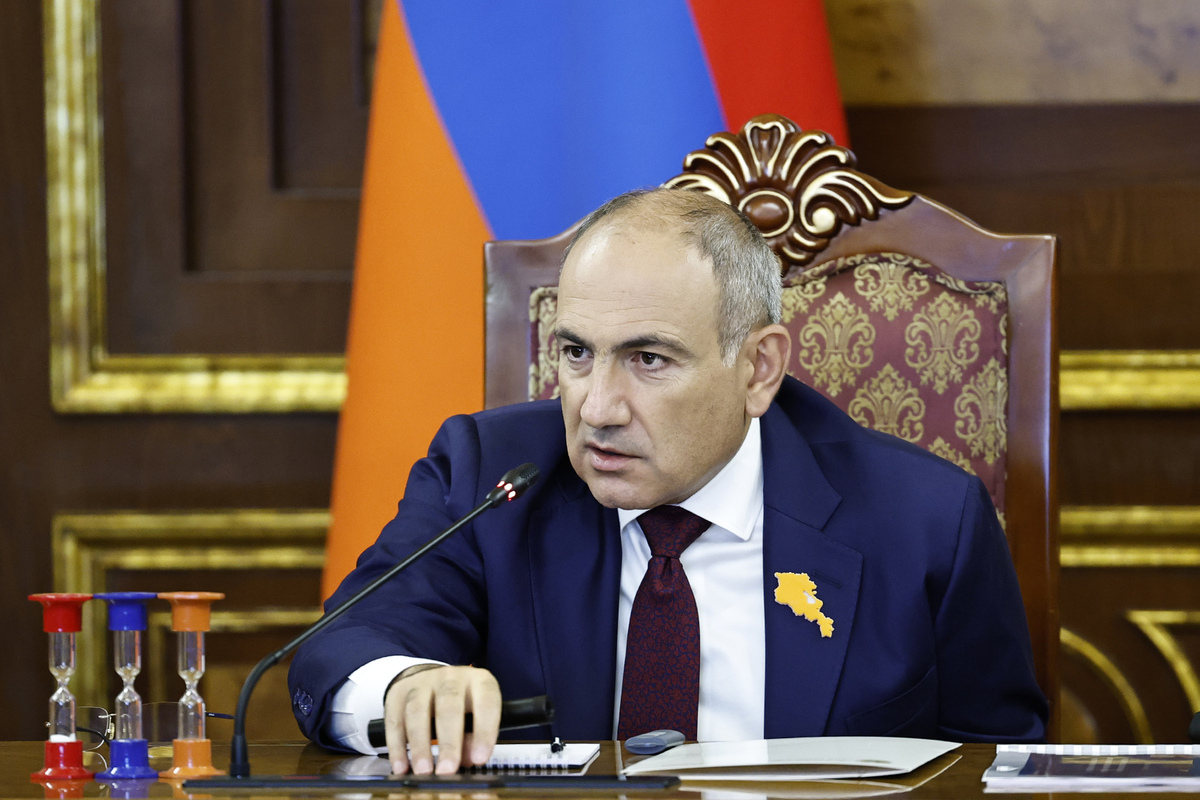
The significance of Armenia’s new government program lies not in any single policy announcement, but in the way seemingly separate changes are beginning to form a coherent political model. Yerevan is distancing itself from the Russian-led security architecture, reconsidering Russian control over strategic infrastructure, preparing a new Constitution, moving toward an application for European Union membership, promoting regional connectivity and challenging the traditional political role of the Armenian Apostolic Church. Prime Minister Nikol Pashinyan has explicitly placed this process within the ideology of “Real Armenia” and the transition toward a “Fourth Republic.” The 2026–2031 government program therefore appears less as a collection of sectoral policies than as an attempt to institutionalize a new conception of Armenian statehood.
The changing relationship with the Collective Security Treaty Organization is one of the clearest manifestations of this transition. Armenia remains formally inside the CSTO, yet has frozen its participation, stopped paying membership fees and has no intention of restoring active involvement during the next five years. Pashinyan went even further during the parliamentary debate, saying that he would welcome a decision by the CSTO to expel Armenia, since this would remove the dilemma of whether Yerevan should initiate withdrawal itself. The ambiguity is politically useful: Armenia continues to detach itself from the Russian-led security system without taking the single formal decision that would transform this process into an explicit geopolitical rupture with Moscow.
Moscow, meanwhile, has little reason to accelerate Armenia’s departure. Formal membership preserves at least the possibility that a future Armenian government could restore relations with the organization, while other CSTO members have little interest in becoming involved in the increasingly bilateral dispute between Moscow and Yerevan. The result is an unusual equilibrium in which Armenia remains legally inside an organization from which it has largely withdrawn politically. This gradualism is important because it reflects a broader feature of Pashinyan’s strategy: reducing Russian dependence without necessarily seeking an immediate and comprehensive break with Russia.
The future of Armenia’s railway system illustrates the same approach more clearly. The railway remains under a Russian concession that runs until 2038, but this arrangement is increasingly colliding with Armenia’s plans to become part of new international transport networks. Pashinyan has argued that sanctions affecting Russian entities discourage Western investors, freight operators and commercial partners from using infrastructure managed by Russian Railways, and has therefore proposed transferring the concession to a third country acceptable to both Yerevan and Moscow. Kazakhstan, the United Arab Emirates and Qatar have been mentioned as possible examples of states capable of playing such a role.
For Russia, however, the railway is not simply a commercial asset. It remains one of Moscow’s most important instruments of economic and strategic presence in Armenia, and Russia has shown no indication that it intends simply to relinquish it. This leaves Yerevan with two possible trajectories: a negotiated restructuring of the concession or a more confrontational process built around disputes over investment obligations and the performance of the existing operator. How this issue develops may therefore provide an important indication of whether the broader decline of Russian influence in Armenia will occur through negotiated diversification or institutional conflict.
The constitutional question goes even deeper because it concerns the political foundations of the Armenian state itself. Pashinyan has repeatedly stated that the new Constitution should no longer contain a reference to the 1990 Declaration of Independence, arguing that the declaration reflects the logic of the Karabakh movement and therefore the logic of conflict. This issue also intersects directly with the peace process with Azerbaijan, since Baku has long viewed elements of Armenia’s constitutional framework as creating the possibility of future territorial claims. But reducing the constitutional debate to Azerbaijan would miss its broader significance: Pashinyan is attempting to separate the future political identity of Armenia from the ideological framework within which the Third Republic emerged.
This is the central meaning of the concept of “Real Armenia” and the “Fourth Republic”. The proposed model defines Armenia primarily through its internationally recognized territory of 29,743 square kilometers, its citizens and the practical functions of the state rather than through a wider historical-territorial political agenda. Pashinyan has contrasted the Third Republic, which he describes as having emerged from a logic of conflict, with a Fourth Republic based on peace. Whether this terminology ultimately becomes institutionalized or not, it provides the clearest framework for understanding why constitutional change, relations with Azerbaijan and Türkiye, diversification away from Russia and debates about the role of the diaspora are increasingly becoming interconnected.
Regional connectivity is particularly important because it can provide an economic foundation for this transformation. The government identifies implementation of TRIPP as one of its central priorities, while Pashinyan argues that the project will connect Armenia directly with Azerbaijan, integrate it into the international railway network and create additional connections toward Central Asia, Russia, Iran and the Black Sea. This matters far beyond transport policy. For decades, Armenia’s closed borders with Azerbaijan and Türkiye contributed to a geographical structure that reinforced its economic and strategic dependence on Russia; new routes would gradually create alternatives that simply did not exist under the previous regional order.
The same logic explains Armenia’s increasingly explicit European orientation. Pashinyan has announced that the government will begin preparations for an official application for EU membership, but this should not necessarily be understood as a simple attempt to replace Moscow with Brussels. The government simultaneously describes its foreign policy as “balanced and balancing” and gives particular importance to regionalization — improving relations with Georgia, Iran, Türkiye and Azerbaijan so that Armenia can function more comfortably within its immediate neighborhood. European integration, in this sense, forms one part of a broader strategy aimed at creating alternatives and reducing excessive dependence on any single external actor.
This makes normalization with Azerbaijan and Türkiye strategically important in a way that goes beyond diplomacy. A country with closed borders and unresolved conflicts inevitably needs external security and economic substitutes; a country connected to its neighbors through trade, railways, roads and investment has a fundamentally different set of options. Regional peace could therefore become one of the foundations of Armenia’s geopolitical diversification. In practical terms, the success of the “Real Armenia” strategy depends heavily on whether normalization produces visible economic and security benefits for Armenian society.
The confrontation with the Armenian Apostolic Church should also be understood within this broader transformation. The 2026–2031 government program explicitly calls for changes in the leadership and governance of the Church, including the removal of Catholicos Karekin II and a reform of internal Church rules. The Church leadership has rejected the government’s approach as unconstitutional interference and has accused the ruling force of targeting an institution whose role historically extends far beyond religion.
This conflict therefore concerns more than the position of one Catholicos. The Armenian Apostolic Church has for centuries played an important role in maintaining national identity, particularly within the diaspora and during periods when Armenians lacked independent statehood. Redefining its relationship with the government inevitably becomes part of a wider debate about the relationship between the modern Armenian republic, historical identity and institutions that traditionally claimed a role in representing the Armenian nation beyond the borders of the state.
When these processes are considered together, the scale of the transformation becomes clearer. Distancing from the CSTO, reconsidering Russian management of strategic infrastructure, preparing a new Constitution, moving toward the EU, normalizing relations with Azerbaijan and Türkiye, developing TRIPP and challenging the traditional political role of the Church are not simply simultaneous reforms. They all point toward an attempt to replace the architecture created by the late Soviet period and the Karabakh movement with a model centered on recognized borders, regional integration, diversified foreign relations and the interests of the Republic of Armenia as a state.
The different parts of this strategy also depend on one another. Peace with Azerbaijan can make regional communications possible; open communications can diversify trade and attract investment; economic alternatives can reduce dependence on Russia; and successful normalization can provide political legitimacy for constitutional and institutional reforms. But the relationship works in reverse as well. A breakdown in the peace process, confrontation with Moscow or deep domestic polarization over the Constitution and the Church could weaken several components of the transformation simultaneously.
This is why the next five years will be particularly consequential. By 2031, Armenia could have a new Constitution, a substantially different relationship with Russia, deeper institutional ties with Europe, functioning transport links with Azerbaijan and Türkiye and a different balance between the state, the Church and the diaspora. Such an outcome would amount to considerably more than a foreign-policy pivot.
For more than three decades, Armenia’s political model was shaped to a large extent by the Karabakh conflict and the geopolitical system that developed around it. The project now associated with “Real Armenia” attempts to reverse that relationship: rather than allowing the legacy of the conflict to define the Armenian state, the state would define its interests through its existing territory, citizens, economic development and relations with its neighbors.
Whether that project succeeds remains uncertain. But the direction is increasingly clear. Armenia is not simply reconsidering its alliances; it is attempting to redefine what kind of state it intends to be after the end of the political era created by the Karabakh movement.