

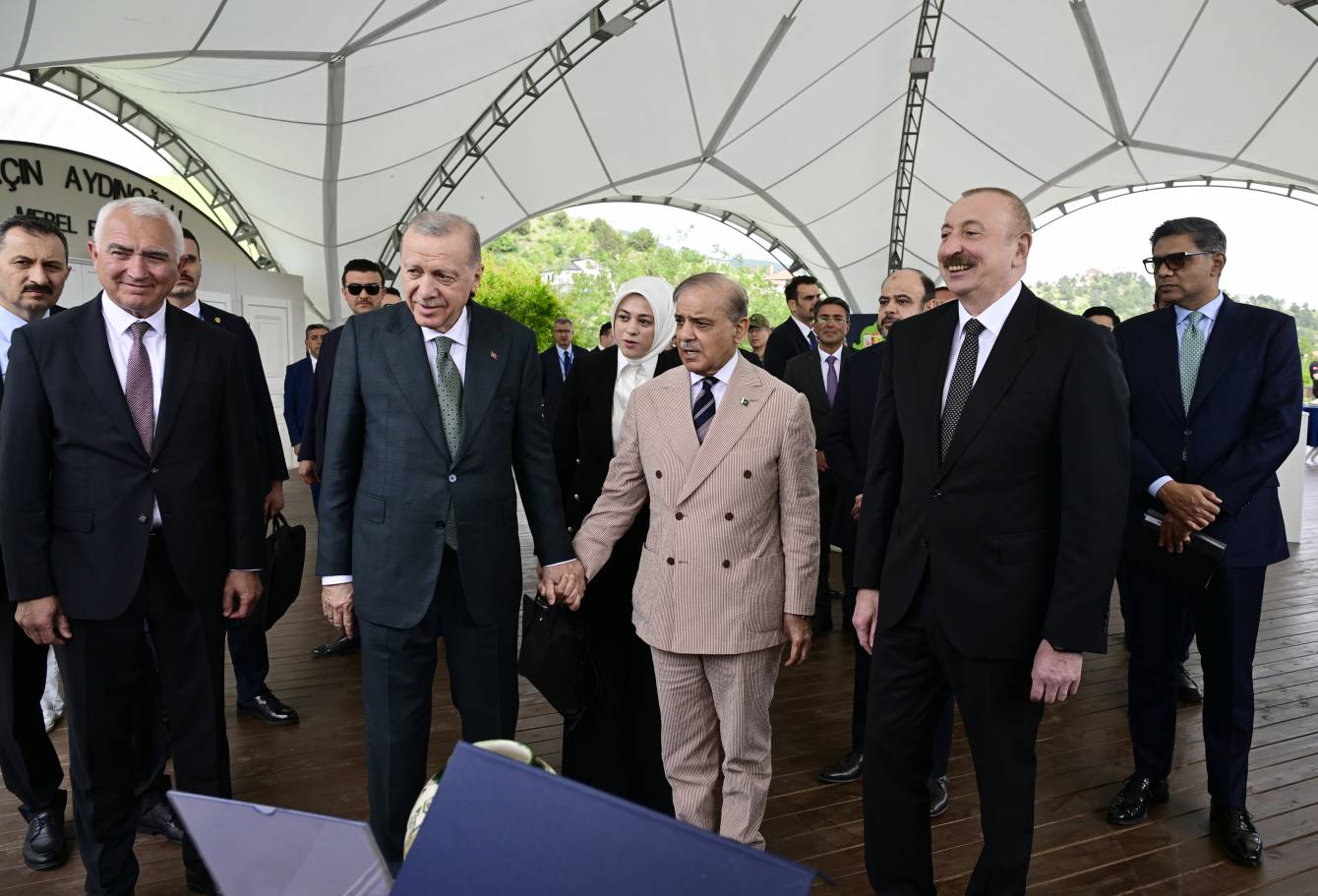
On May 28, 2025, Azerbaijan marked its Independence Day — the country’s principal national holiday, commemorating not only the historical proclamation of the Azerbaijan Democratic Republic but also affirming Azerbaijan’s contemporary political and civilizational agency. This year’s events acquired particular symbolic and strategic resonance. The focus was not on Baku, as tradition would suggest, but on the city of Lachin, where a series of events unfolded that extended far beyond the standard format of national celebration: the official inauguration of the Lachin International Airport, visits by President of the Republic of Türkiye Recep Tayyip Erdoğan and Prime Minister of the Islamic Republic of Pakistan Muhammad Shehbaz Sharif, bilateral meetings, a trilateral Azerbaijan–Türkiye–Pakistan summit, and a large-scale cultural event — an open-air Independence Day concert.
The choice of Lachin as the symbolic and political center of the day’s events was deliberate. For three decades, this city had been under Armenian occupation, reduced to a zone of destruction and dense minefields. Today, Lachin is emerging as a strategic node — not only in the context of territorial reintegration, but also in terms of political control, economic infrastructure, and humanitarian presence. The international airport — built in record time and the third of its kind on liberated territories — is direct evidence that Azerbaijan’s efforts go beyond post-conflict recovery. It reflects a long-term strategic planning framework aimed at shaping a sustainable future. Parallels can be drawn with early 20th-century urban development: in Chicago, streetcar lines were extended deep into the prairies in anticipation of future suburban expansion; in New York, a central station was constructed with 114 platforms before the city had grown into the metropolis it is today.
The international airports established on Azerbaijan’s liberated territories represent more than logistical infrastructure; they are foundational pillars of a new political-economic geography. They facilitate not only the return of internally displaced persons but also enable the emergence of new economic models — including green energy, international tourism, and digital innovation hubs. Furthermore, they serve to strengthen national sovereignty by enhancing the physical connectivity of a once-fragmented national space, previously divided by frontlines and foreign military presence.
Within this broader framework, the trilateral Azerbaijan–Türkiye–Pakistan summit held in Lachin stands out as a particularly significant development. The statements delivered during the summit cannot be reduced to gestures of goodwill or symbolic solidarity. What emerged was a coordinated political alignment expressed through a strategic format. Presidents Ilham Aliyev and Recep Tayyip Erdoğan, along with Prime Minister Muhammad Shehbaz Sharif, did not merely share their assessments of regional and global challenges; they collectively articulated a shared intent to pursue decisive joint policies in a trilateral configuration.
In effect, a new architecture of regional cooperation was outlined — one that is not based on traditional bloc structures but on the coordinated actions of three sovereign states with tangible capacities for influence. The alliance reaffirms core principles: respect for territorial integrity, sovereignty, and justice. In his speech, President Aliyev emphasized, “Azerbaijan, Türkiye, and Pakistan have always stood on the side of justice, international law, and territorial integrity. Today, we reaffirm the unity of our peoples.” These remarks, delivered in Lachin — a city that for decades symbolized unresolved conflict — carry distinct weight and geopolitical significance.
The format of the summit itself carried multiple symbolic layers. Lachin’s trajectory — from a site of military defeat and humanitarian catastrophe in the 1990s to a hub of new Eurasian cooperation — demonstrates that Azerbaijan understands territory not merely as a space for reconstruction, but as a strategic resource. It was here, in 2020, that Azerbaijan fully reasserted control over its borders, terminated the transit function of the so-called Lachin Corridor, and ended the foreign military presence on its soil. Now, the same location hosts discussions of new forms of multilateral engagement that go beyond conventional diplomacy.
One element that drew particular attention was the arrival of the Pakistani Prime Minister aboard a military aircraft. In combination with statements about joint readiness to counter emerging threats, this move is widely interpreted as an indication that the alliance encompasses a concrete defense dimension. In a context where destabilization risks remain — including residual manifestations of Armenian revanchism, irregular threats, and interference by third parties — coordinated military preparedness constitutes a strategic deterrent.
It is also noteworthy that the deepening cooperation among these three countries is taking place against the backdrop of a rapidly evolving global order. Azerbaijan, Türkiye, and Pakistan are all expanding their strategic partnerships with the People’s Republic of China. This creates the conditions for constructing a flexible coalition capable of operating independently of established ideological frameworks and subordinated power structures. In this respect, the Baku–Ankara–Islamabad axis can be understood as an emerging geopolitical alignment grounded in multilateralism, regionalization, and strategic autonomy.
Looking ahead, the trilateral format could serve as the foundation for a broader coalition of states interested in alternative models of global governance. There is already reason to believe that the platform could be expanded to include countries from Central Asia, the Middle East, and the wider Islamic world. Such developments would further imbue the initiative with both civilizational and integrative dimensions.
Taken together, the events in Lachin on May 28, 2025, constituted not merely a commemorative act of national significance but also a consolidation point for a new regional paradigm. Azerbaijan, Türkiye, and Pakistan — three states shaped by postcolonial experience, regional awareness, and a tradition of independent foreign policy — demonstrated their readiness not only to respond to existing challenges but to shape new mechanisms of political equilibrium in a world marked by systemic volatility. In this sense, Lachin is no longer just a symbolic site of victory — it has become a locus of strategic design.