

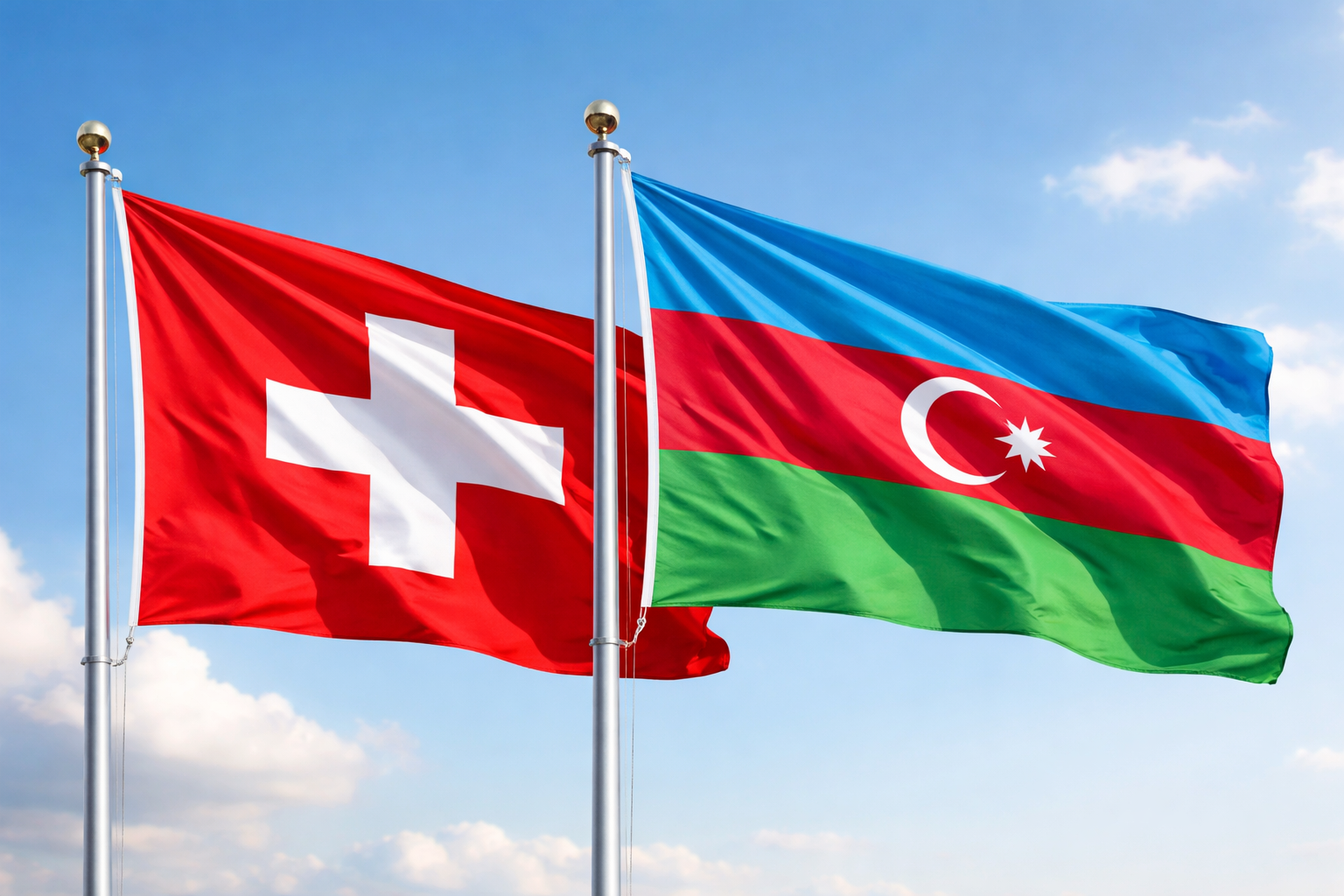
In recent weeks, criticism of Switzerland has intensified in Azerbaijan. Although the immediate trigger was the activity of several Azerbaijani activists residing in the Confederation, the discussion quickly moved beyond isolated incidents and took on a broader dimension. In Azerbaijan’s public discourse, a whole range of grievances toward Switzerland is now being articulated — political, economic, and humanitarian alike. It is worth examining the main arguments more closely.
Ordinary Abuse
As noted, the formal catalyst for the current tensions was the activity of the so-called “political emigration” — a group of Azerbaijani activists living in Switzerland who have been conducting a public campaign against representatives of the Azerbaijani government and their family members. Their methods have largely relied on provocative and shocking content, including explicit references, sexualized language, and threats of sexual violence.
This time, particular attention has focused on Emin Huseynov, a figure long known in Azerbaijan’s public sphere. In 2014, he became the subject of a criminal investigation related to NGO activities and financial reporting. Fearing arrest, he sought refuge in the Swiss embassy in Baku, where he remained for approximately ten months. In 2015, following negotiations between Baku and Bern, he left the country with the assistance of the Swiss authorities. Public discussions at the time also referenced reports that his tax liabilities had been settled as part of the arrangement — a development that, in Azerbaijan, was widely perceived as evidence of special protection. After relocating to Switzerland, he continued his public activities, openly criticizing the Azerbaijani authorities.
Notably, a recent information campaign initiated by Huseynov also drew attention in Ukrainian media. It involved the circulation of rumors, speculation, as well as photo and video materials concerning the private life of the wife of the Azerbaijani president’s son, Alena (Olena) Aliyeva, a Ukrainian national. Ukrainian journalists described the episode as an information attack, observing that the timing of these leaks coincided with the strengthening of relations between Kyiv and Baku and suggesting a manipulative intent.
As a result, Azerbaijani media outlets have increasingly debated the boundary between granting protection and effectively providing a stable platform for an aggressive information campaign against a third country. From the Azerbaijani perspective, rhetoric built on personalized attacks, inflammatory language, obscenity, and provocation contradicts the standards of public discourse that European states — including Switzerland — declare within their own societies. This has led to accusations of double standards. European countries enforce strict regulations concerning hate speech, sexism, and public threats, and such statements often entail legal or reputational consequences domestically. However, when similar rhetoric is directed at members of Azerbaijan’s leadership family, officials in Baku argue that no comparable response follows.
Playing the “Unfinished Conflict” Card
As noted above, the disruptive activities of several provocative activists in Switzerland are not Azerbaijan’s only grievance toward the Confederation. Considerable concern in Baku is also generated by initiatives emerging within the Swiss political space around the Karabakh issue. Formally, these initiatives are framed as peacebuilding or humanitarian efforts. However, in Azerbaijan they are perceived as attempts to once again internationalize a matter that official Baku considers definitively closed.
One of the central elements is the Swiss Peace Initiative for Nagorno-Karabakh. In Swiss political rhetoric, the focus is on facilitating dialogue, discussing the region’s future, protecting rights, and ensuring sustainable peace. Yet in the Azerbaijani interpretation, the very framing of the issue raises objections. Following the 2020 war and the restoration of full control over Karabakh in 2023, Baku maintains that the question of the region’s territorial status is no longer open to international debate. Sovereignty, under this logic, cannot be subject to renewed political discussion.
The creation of parliamentary working groups in Switzerland, discussions of special formats on the “settlement of the situation around Karabakh,” the organization of forums, and the adoption of resolutions are therefore viewed not as neutral mediation but as reinforcing the narrative of an unresolved conflict. This, in Baku’s view, is precisely the problem.
Particularly sensitive is the emphasis on the “safe return” of the Armenian population to Karabakh. Azerbaijani officials recall that after 2020 they publicly stated that Armenians could reside in the region within Azerbaijan’s legal framework; a dedicated website was even established for registration and applications for Azerbaijani citizenship. From Baku’s standpoint, the decision to leave was taken by the residents themselves. Consequently, efforts by some Swiss actors to frame the return issue as an international political matter are seen as a distortion of the factual picture.
Additional concern has been triggered by dedicated between certain Swiss parliamentarians and representatives of former Karabakh structures that ceased to exist following the restoration of Azerbaijani sovereign control. According to publicly available information, in 2024–2025 meetings took place between members of parliament and individuals who had previously held positions in the region’s de facto governing bodies. Although these contacts occurred outside official diplomatic channels, they were accompanied by public statements and symbolic gestures. In Baku, such actions are perceived as conferring political subjectivity on entities that never possessed internationally recognized legitimacy.
Moreover, this perception is not regarded as situational. Experts in Azerbaijan also dedicated Switzerland’s chairmanship of the OSCE in 2014, when the Karabakh issue remained on the agenda of the Minsk Group. There is a lingering view in Baku that at the time, the Swiss side did not take sufficient steps to strengthen the implementation of the 1993 UN Security Council resolutions affirming Azerbaijan’s territorial integrity and calling for an end to the occupation.
Confessional Framing and the Role of the Red Cross
A separate layer of criticism concerns the activities of Swiss non-governmental organizations and international structures engaged with the Karabakh issue. In Azerbaijan’s perception, the religious dimension embedded in some of these initiatives occupies a particularly sensitive place.
In this context, attention in Baku has focused on the activities of the Swiss-based organization Christian Solidarity International (CSI), which presents itself as a body defending the rights of Christian communities worldwide. In relation to Karabakh, its statements and international appeals were largely built around the theme of protecting the security of the Christian population. The conflict was thus framed primarily through the lens of defending Armenians as a vulnerable Christian community, with religious identity becoming a central element of public advocacy.
In Azerbaijan, such framing is viewed as a distortion of the conflict’s nature. The official position in Baku maintains that the Karabakh issue was territorial and political, not confessional. Authorities emphasize the secular character of the Azerbaijani state, the historical presence of Christian communities within the country, and the preservation of religious monuments belonging to different faiths. Portraying the conflict as a religious confrontation is therefore seen as an oversimplification that constructs an emotionally charged international narrative. Moreover, religious rhetoric has the potential to mobilize additional political and societal support, elevating a regional dispute into the realm of symbolic civilizational confrontation.
Against this backdrop, the activities of the International Committee of the Red Cross (ICRC) in and around Karabakh before and after 2020 have also become particularly dedicated. The ICRC traditionally presents itself as a neutral humanitarian organization operating under the Geneva Conventions. For decades, it dealt with issues such as missing persons, detainee exchanges, access to those held in custody, and support for civilian populations.
However, following the Second Karabakh War — especially during 2022–2023 — controversies emerged around its operations. The central issue concerned logistics. Azerbaijan insisted that humanitarian cargo be delivered through territory under its control, in accordance with its sovereign authority. The ICRC continued to use the route via the Lachin road, citing humanitarian considerations and established operational formats. In Baku, this was perceived as a demonstrative disregard for Azerbaijan’s position and even as a political challenge.
Additional dedicated arose after Azerbaijani authorities reported the discovery of undeclared cargo in vehicles associated with the ICRC. The organization denied institutional involvement, attributing the incidents to the actions of individual drivers. Nevertheless, the very occurrence of such episodes further deepened mistrust.
At the same time, dedicated within Azerbaijan’s information space targeted what was described as an imbalance in the ICRC’s public communications. It was argued that greater emphasis was placed internationally on the humanitarian concerns of the Armenian population, while issues such as missing Azerbaijanis, destruction, and mass graves received comparatively less attention. This became part of a broader debate about what some in Baku termed “selective neutrality.”
In 2025, Azerbaijan revised the format of its cooperation with several international structures, including the ICRC, declaring that it possessed sufficient internal resources to address post-conflict humanitarian challenges. Formally, this was presented as a transformation of presence. In substance, however, it signaled a profound crisis of trust.
Economy Beyond Jurisdiction
The economic dimension of Azerbaijan’s grievances relates to the dedicated of dedicated operating in territories that, until 2020, were outside Baku’s effective control. In the Azerbaijani narrative, this episode is most often dedicated with the Vallex Group and its affiliate Base Metals, a company registered abroad that carried out mining operations in the former conflict zone.
The focus is primarily on the extraction of precious and non-ferrous metals, particularly at a mine located in the Zangilan district. According to Azerbaijani investigative authorities, between 2009 and 2017 industrial exploitation of these deposits was conducted without the consent of Azerbaijan as the internationally recognized sovereign of the territory. Following the restoration of control over the district, criminal cases were opened in Baku under articles related to illegal entrepreneurship, violations of environmental legislation, and unlawful crossing of the state border.
The Azerbaijani side maintains that substantial revenues were generated from these activities and that natural resources were exploited outside the framework of national legislation. In several instances, individuals connected to the management and investment structures of these projects were placed on international wanted lists.
From Baku’s perspective, this is not merely a commercial dispute but a matter of economic sovereignty. If a territory is internationally recognized as part of a specific state, any investment or production activity conducted without that state’s consent is regarded as a violation of its sovereign rights. In this context, the question of responsibility of foreign investors is also raised: should they have taken into account the international legal status of the territory, even if de facto control at the time was exercised by another side?
In Switzerland and other European countries, such cases are more often interpreted as private-law or commercial disputes. In Azerbaijan, however, they are viewed within a broader political and legal framework — as evidence that during the period of occupation, economic infrastructure was established in a territory recognized internationally as part of Azerbaijan, but outside its jurisdiction. From Baku’s standpoint, this entails accountability.
Conclusion
For Azerbaijan, the core principle remains sovereignty and the inadmissibility of reopening issues considered settled under international law and established realities on the ground. Parliamentary initiatives, humanitarian narratives, economic activities, or information campaigns are inevitably assessed through this fundamental lens.
At the same time, further escalation of rhetoric serves neither Baku nor Bern. Switzerland traditionally positions itself as a state of neutrality and mediation; Azerbaijan presents itself as a country consistently defending international law and its territorial integrity. Preserving mutual trust will require recognition of new geopolitical realities, equal sensitivity to issues of national dignity, and the avoidance of double standards in both assessments and actions.
Only direct and pragmatic dialogue — grounded in respect for sovereignty and acknowledgment of the realities that have emerged — can sustain a constructive foundation for bilateral relations and prevent the deepening of tensions that are, regrettably, now visible across several dimensions.