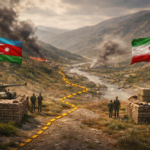


In August 2025, a series of developments in Switzerland demonstrated the resilience of the country’s federal institutions to external political pressure and reflected its diplomatic stance on the Armenia–Azerbaijan conflict. Over the course of several days, both the Federal Parliament and the Federal Council rejected initiatives promoted by representatives of the Armenian diaspora lobby and associated revanchist groups concerning Karabakh and Armenian nationals held in Azerbaijan. These decisions came against the backdrop of significant progress in the peace process between the two countries, achieved at a meeting in Washington with the participation of the US President.
The initiative, formally titled “Annexation of Nagorno-Karabakh. Release of Political Prisoners in Azerbaijan,” was introduced to the Geneva Cantonal Parliament in 2024. Under Switzerland’s constitutional framework, foreign policy matters fall within the exclusive competence of the Confederation, and resolutions adopted by cantonal parliaments on international issues have no legal force without the approval of the Federal Assembly. Nevertheless, the document was referred to the Council of States, where on 11 August 2025 it was reviewed by the Foreign Affairs Committee. The Committee unanimously decided not to bring the initiative to a plenary session, citing its one-sided nature and incompatibility with the Federal Parliament’s mandate.
Anticipating an unfavourable outcome, one of the sponsors, MP Carlo Sommaruga, proposed a revised version that removed references to “annexation” and focused on the release of Armenian prisoners and the protection of cultural heritage in Karabakh. This version also failed to gain approval, receiving five votes against, four in favour, and three abstentions.
The very next day, the Federal Council issued an official response to an inquiry from MP Erich von Tobel regarding the possibility of holding a “Nagorno-Karabakh Peace Forum” in Switzerland with the participation of Armenian representatives. In the document prepared by the Federal Department of Foreign Affairs (FDFA), it was emphasised that Switzerland does not recognise Karabakh as a state entity and therefore does not maintain contacts with its so-called representatives. The Swiss authorities’ official counterparts are the governments of Armenia and Azerbaijan. During political consultations with the foreign ministries of both countries in spring 2025, both sides confirmed that their priority is to conclude a peace agreement and normalise bilateral relations. It was noted that on 13 March 2025 Armenia and Azerbaijan had agreed on the text of a peace treaty, and negotiations toward its signing are ongoing. The Azerbaijani side made it clear that it does not consider holding the forum provided for in the resolution. On this basis, the Federal Council concluded that implementing such an initiative is currently impossible and reaffirmed Switzerland’s readiness to offer its good offices only within a format acceptable to both parties.
These decisions by Swiss institutions came only a few days after an important diplomatic event. On 8 August 2025, a trilateral meeting took place in Washington between Azerbaijani President Ilham Aliyev, Armenian Prime Minister Nikol Pashinyan, and US President Donald Trump. As a result of the talks, the parties initialled a draft peace treaty and signed a declaration of readiness to normalise relations. Notably, issues related to Armenian detainees or the return of the Armenian population to Karabakh were not included in these documents, indicating that such matters have been removed from the official negotiation agenda.
In this context, attempts to reintroduce these issues into the international discussion through cantonal parliamentary initiatives appear inconsistent with the current trajectory of the peace process. According to observers, certain diaspora networks — often at odds with the current Armenian government’s more pragmatic approach — remain interested in keeping the conflict alive in the public sphere, as it sustains their political relevance, access to resources, and influence over the narrative. Within Switzerland, the situation illustrates how external interest groups may try to use cantonal political mechanisms to send foreign policy signals that do not align with the Federal Council’s position.
The reaction of federal authorities showed that Switzerland remains committed to the principles of non-interference in bilateral negotiations, respect for the international legal framework, and preservation of its role as a mediator. Its readiness to provide good offices is limited to conditions agreed upon by the conflict parties themselves. This approach helps maintain trust on both the Azerbaijani and Armenian sides, which is essential for retaining Switzerland’s mediation potential.
Ultimately, the August decisions of Swiss institutions were not only an example of institutional resilience to external lobbying pressure but also a signal that the peace process between Armenia and Azerbaijan has entered its final phase. For Swiss diplomacy, this means a strengthening of its reputation as a reliable mediator operating strictly within the framework of international law and with full respect for the sovereignty of the parties, and for international observers it serves as an important indicator of shifting political dynamics in the South Caucasus.