

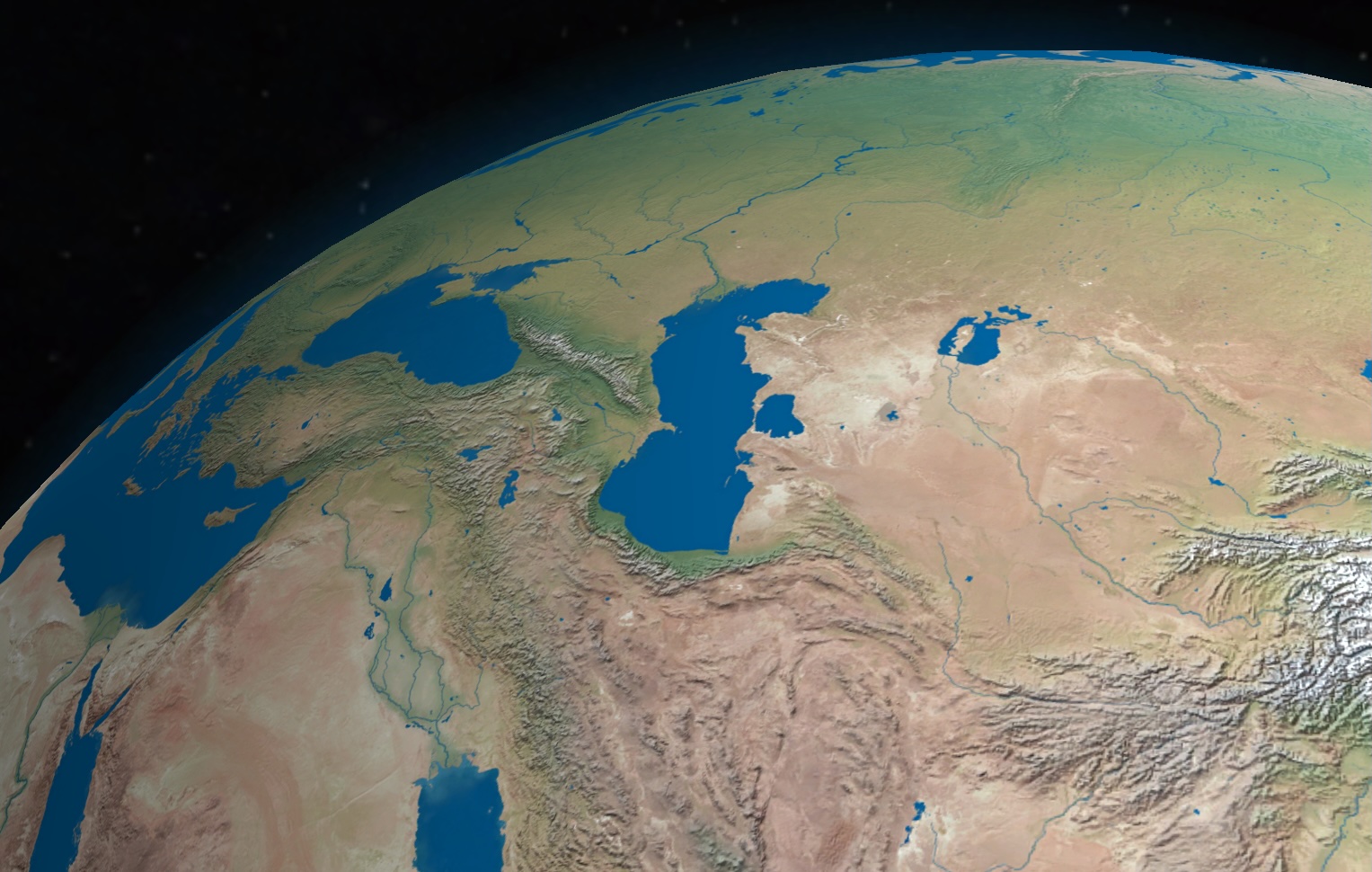
The steady decline in the level of the Caspian Sea is emerging as one of the most acute transboundary environmental challenges in Eurasia. According to the latest measurements, the sea’s water level has reached a historic low of -29.21 meters. This poses significant risks not only to the region’s biodiversity and ecosystems, but also to the economic stability, social infrastructure, and transport and logistics networks of all littoral states.
The most immediate threat is linked to the ongoing desiccation of the northeastern Caspian coast, where Kazakhstan’s key ports—Aktau and Kuryk—are already experiencing disruption. Yet the consequences are not confined to one country. Environmental degradation is accelerating across the basin: the surface area of the sea is shrinking, while spawning grounds and habitats for species such as the Caspian seal and sturgeon have decreased by several dozen percent. These developments pose a direct threat to Azerbaijan’s fishing sector and other regional economies.
A key driver of the sea’s retreat is the decreasing inflow of freshwater, primarily from the Volga River, which accounts for up to 80% of the Caspian’s total inflow. According to open sources, only 207 cubic kilometers of water reached the sea in 2023. This dynamic is the result of both climatic and anthropogenic factors: increased water withdrawal in the upper Volga, expansion of agriculture, reservoir filling, and elevated evaporation rates due to rising temperatures. Additionally, the Caspian’s level is subject to long-term natural fluctuations, requiring consideration of both seasonal and cyclical variables.
Anthropogenic impacts are amplifying natural variability. The Caspian’s strategic vulnerability is most apparent in the logistics sector. A further drop of five meters could render key port infrastructure inoperable. This is particularly troubling in light of Azerbaijan’s long-term geoeconomic ambitions, which rely on transforming Baku and other ports into key East–West transit hubs. A destabilized hydrological regime places the long-term viability of the Trans-Caspian International Transport Corridor at serious risk.
This has led to discussions around potential legal mechanisms to limit upstream water extraction from the Volga. Yet the main obstacle lies in Russia’s refusal to recognize the Volga as a transboundary river, and its rejection of international obligations regarding minimum water outflow. This stance poses serious challenges for Kazakhstan and other states seeking to maintain a basic water balance in the Caspian. Unilateral action is insufficient; a multilateral diplomatic framework involving all five littoral states—Azerbaijan, Kazakhstan, Russia, Turkmenistan, and Iran—is urgently needed.
One possible solution involves reactivating the provisions of the Tehran Convention on the Protection of the Marine Environment of the Caspian Sea. While the Convention formally provides a platform for cooperation on environmental protection and pollution control, its practical potential remains largely untapped. In particular, the Aktau Protocol on pollution from land-based sources offers a possible avenue for harmonized approaches to water quality standards, pollutant concentration limits, environmental monitoring, and, where necessary, sanctions for non-compliance.
Meanwhile, public support for protecting the Caspian is growing. Environmental campaigns launched in Kazakhstan and other countries have emphasized the need for shared responsibility over the sea’s future. However, such efforts remain fragmented. Without the active involvement of all stakeholders—including scientific institutions and civil society organizations—long-term outcomes are likely to remain limited. The Caspian issue can no longer be viewed as the internal affair of any one country; it is a regional challenge that demands consensus and coordination.
The urgency of the situation points to the need for a working group composed of all littoral states. Such a group could develop technical responses, coordinate scientific research, assess long-term water regulation scenarios, and define common principles for regional water governance. Only through broad-based support can the region establish legitimate levers of influence—even in the absence of immediate political will from all parties.
The stakes are rising beyond environmental degradation alone. The falling water level is already complicating vessel navigation in key ports such as Makhachkala, Astrakhan, Kuryk, and Baku. Transport schedules are disrupted, delays are growing, and operational costs are rising. In broader terms, the East–West corridor linking China, Central Asia, the Caucasus, and Europe is becoming more vulnerable.
Addressing the growing ecological stress on the Caspian requires building a new architecture of trust and cooperation. This is not only about water regulation—it is about preserving the integrity of the Caspian space as a whole. The loss of the Caspian as an ecological, logistical, and economic system would be a blow to the entire region. The Aral Sea disaster has already shown the cost of delayed action. In the case of the Caspian, there is still a narrow window for mitigation—but it is closing fast.