

The upcoming visit of U.S. Vice President J.D. Vance to Azerbaijan marks more than a high-level diplomatic engagement. It reflects a broader reassessment underway in Washington regarding the role of the South Caucasus within the evolving global and regional order. When a new administration assumes power in the United States, early foreign policy signals tend to be deliberate—and the choice to prioritize engagement with Azerbaijan at this stage is indicative of a shift in strategic thinking rather than a routine gesture.
For decades, the South Caucasus was largely perceived in Washington as a secondary theater—an area shaped primarily by the interests of other powers and approached through cautious, often declarative diplomacy. This perception is now eroding. The region is increasingly viewed as an independent strategic space whose importance is amplified by changes in global security architecture, the reconfiguration of transport and energy routes, and the decline of rigid geopolitical hierarchies inherited from the post–Cold War era.
Against this backdrop, the Trump administration appears intent on moving beyond symbolic engagement toward a model grounded in direct participation. The emphasis is no longer limited to political dialogue or conflict management frameworks, but extends to infrastructure, investment, security cooperation, and institutional presence. This transition from declarative policy to practical involvement represents a qualitative change in the U.S. approach to the region.
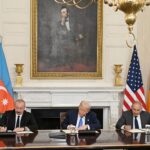
Azerbaijan occupies a central place in this recalibrated strategy. Over recent months, bilateral contacts between Baku and Washington have intensified, taking the form of leader-level communication, diplomatic exchanges, and discussions of long-term cooperation frameworks. These interactions have allowed Azerbaijan to articulate its vision for regional development and its expectations of partnership with the United States directly to the new administration—without intermediaries or inherited assumptions.
Particularly noteworthy is the growing convergence around the idea that U.S. engagement should be anchored in tangible projects. Among them, connectivity initiatives linking the South Caucasus to wider Eurasian and transcontinental networks have emerged as a focal point. In this context, U.S. involvement is envisioned not as supportive or observational, but as structurally decisive—signaling Washington’s readiness to act as a stakeholder rather than a distant guarantor.
At the same time, the reassessment of U.S.–Azerbaijan relations inevitably raises the question of institutional constraints that have historically limited their depth. Legacy mechanisms designed for a different geopolitical era now sit uneasily with the objectives of a forward-looking partnership. Their continued relevance is increasingly questioned within U.S. political discourse, reflecting a recognition that outdated restrictions undermine not only bilateral cooperation but also Washington’s broader strategic ambitions in the region.
Security cooperation constitutes another critical dimension of this evolving relationship. Azerbaijan’s long-standing efforts to modernize its armed forces in line with contemporary standards and to enhance interoperability with Western partners have created a foundation for more substantive engagement. In an environment marked by persistent uncertainty and regional volatility, military-technical cooperation is viewed in Baku not as an abstract alignment choice, but as a pragmatic necessity for safeguarding national stability.
The visit of the U.S. vice president thus serves as a convergence point for multiple trajectories: the United States’ search for durable influence through long-term engagement, Azerbaijan’s pursuit of diversified partnerships that reinforce its strategic autonomy, and the region’s broader transition toward a post-conflict, connectivity-driven future. Importantly, the visit should be understood not as an endpoint, but as part of a process aimed at translating political intent into operational reality.
More broadly, increased U.S. involvement contributes to a more balanced regional configuration. The South Caucasus is no longer a passive arena shaped exclusively by external rivalries, but a space where regional actors actively define their development paths. A sustained and pragmatic U.S. presence—anchored in concrete cooperation rather than rhetoric—adds an additional layer of resilience to this emerging order.
Ultimately, the significance of the moment lies not in ceremonial diplomacy, but in whether declared intentions are followed by systemic action. If current signals translate into institutional commitments, the U.S.–Azerbaijan relationship may evolve into a durable partnership aligned with the realities of a rapidly changing geopolitical landscape.