

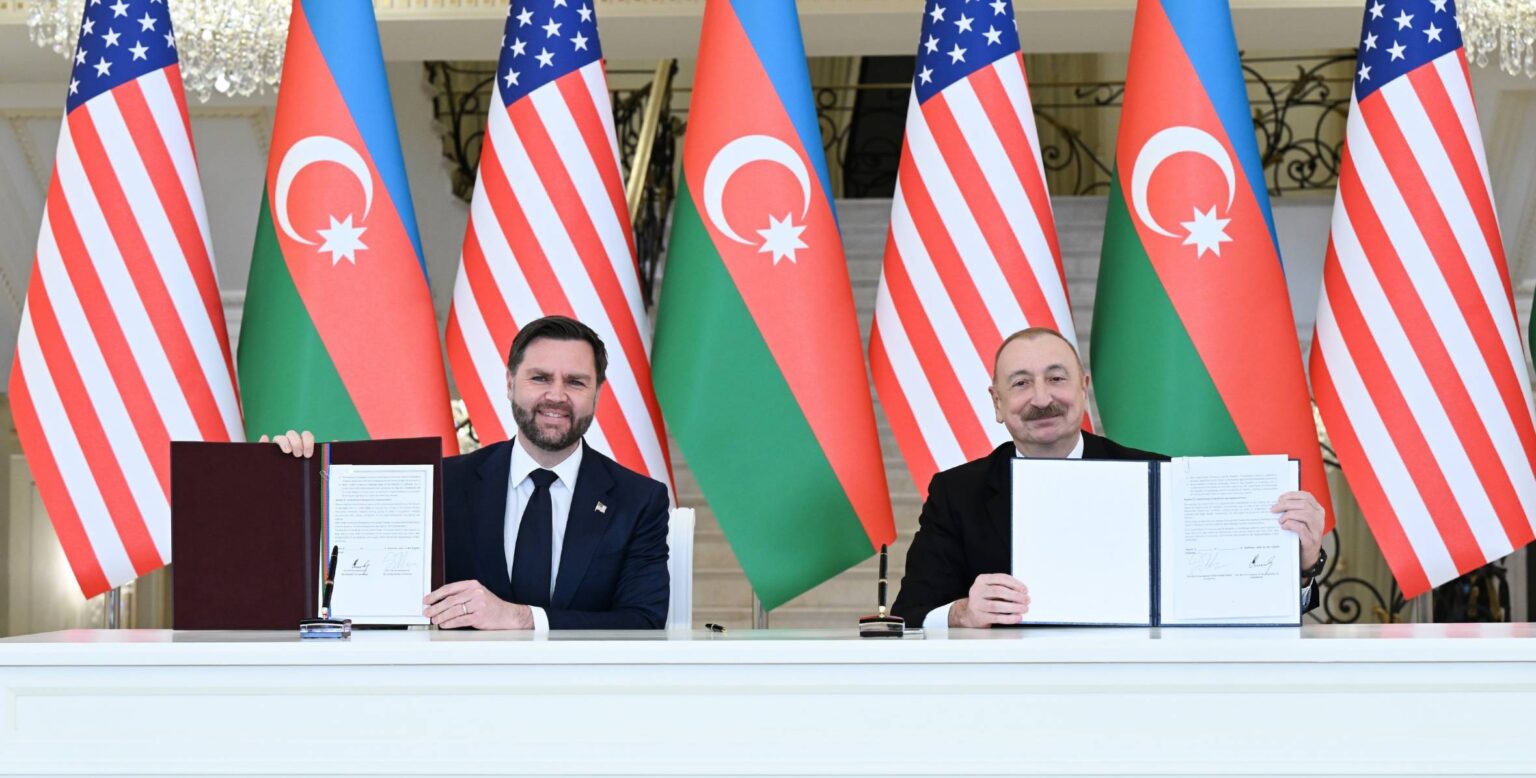
The visit of U.S. Vice President J.D. Vance to the region and the signing of the Strategic Partnership Charter between Baku and Washington were not isolated diplomatic episodes, but rather the logical continuation of a broader process — the gradual transition of Azerbaijani-American relations to a fundamentally new level. Behind political statements, a practical agenda is becoming increasingly visible: investment, technological cooperation, infrastructure development, and the shaping of a new geoeconomic configuration in the South Caucasus.
Many observers consider President Ilham Aliyev’s visit to Washington in August 2025 to be the starting point of this new phase. It was then that active preparations began for expanding economic ties, including the creation of a working group to draft the Charter. Since that time, contacts have taken on a systemic character: Azerbaijani delegations have regularly visited the United States, discussing investment projects, the development of the Middle Corridor, defence-industrial cooperation, and the expansion of trade relations. The signing of the Charter in Baku became the institutional consolidation of this process.
The document itself covers a broad range of areas — from energy and regional connectivity to the digital economy and artificial intelligence. The United States has expressed interest in developing transport and energy infrastructure, including projects within the framework of TRIPP, aimed at strengthening the region’s transit potential and reinforcing links between Europe and Asia. In this context, Azerbaijan is viewed as a key node of global logistics routes, benefiting from its unique geographic location and already established infrastructure — pipelines, railways, and power transmission lines.
The economic dimension of the partnership is becoming increasingly tangible. The visit of a U.S. Chamber of Commerce delegation and representatives of 31 American companies — including Apple, Meta, ExxonMobil, Boeing, J.P. Morgan, and Mastercard — demonstrated the practical interest of business in the Azerbaijani market. The sides discussed projects in energy, finance, IT, and telecommunications, including the construction of data centers and the development of artificial intelligence and cybersecurity initiatives. American digital solution providers are already active in Azerbaijan, while the national financial sector is rapidly expanding cashless infrastructure with the participation of international payment systems.
Particular attention is being paid to energy — the traditional foundation of bilateral relations. SOCAR and ExxonMobil are considering joint participation in the development of hydrocarbon fields, as well as cooperation in renewable energy and the introduction of modern technologies to enhance production efficiency. At the same time, Baku is pursuing diversification through green energy development, the construction of new power transmission lines to Europe, and the use of surplus electricity capacity for future artificial intelligence and data processing projects. According to President Ilham Aliyev, by 2032 the country plans to add up to eight gigawatts of solar and wind generation, creating the foundation for Azerbaijan to become a regional hub for data centers and digital services.
Experts note that the Charter also opens new avenues of cooperation, including civilian nuclear energy, research and development, and innovation platforms. These areas could become drivers of industrial growth and strengthen Azerbaijan’s position as a contributor to Europe’s energy security. The document also highlights the expansion of defence cooperation — from counterterrorism efforts to the protection of critical infrastructure — reflecting Azerbaijan’s growing role within the regional security architecture.
On a broader level, these developments signal a transformation of the geopolitical balance in the South Caucasus. By pursuing a multi-vector foreign policy, Azerbaijan is steadily reinforcing its position as an independent actor capable of attracting major global corporations and integrating into emerging economic chains. The United States, for its part, is prioritising partnerships with countries that possess resilient infrastructure and increasing regional influence, seeking to anchor itself in projects related to connectivity, energy, and digital technologies.
Thus, Vance’s visit and the signing of the Charter represent not only a symbol of political rapprochement, but also a reflection of a deeper trend — the transition of Azerbaijani-American relations into a framework of long-term economic and technological cooperation. If the declared initiatives are implemented, the South Caucasus may ultimately transform from a peripheral space into one of the key nodes of global competition for routes, resources, and innovation, with Azerbaijan playing an increasingly central role.