

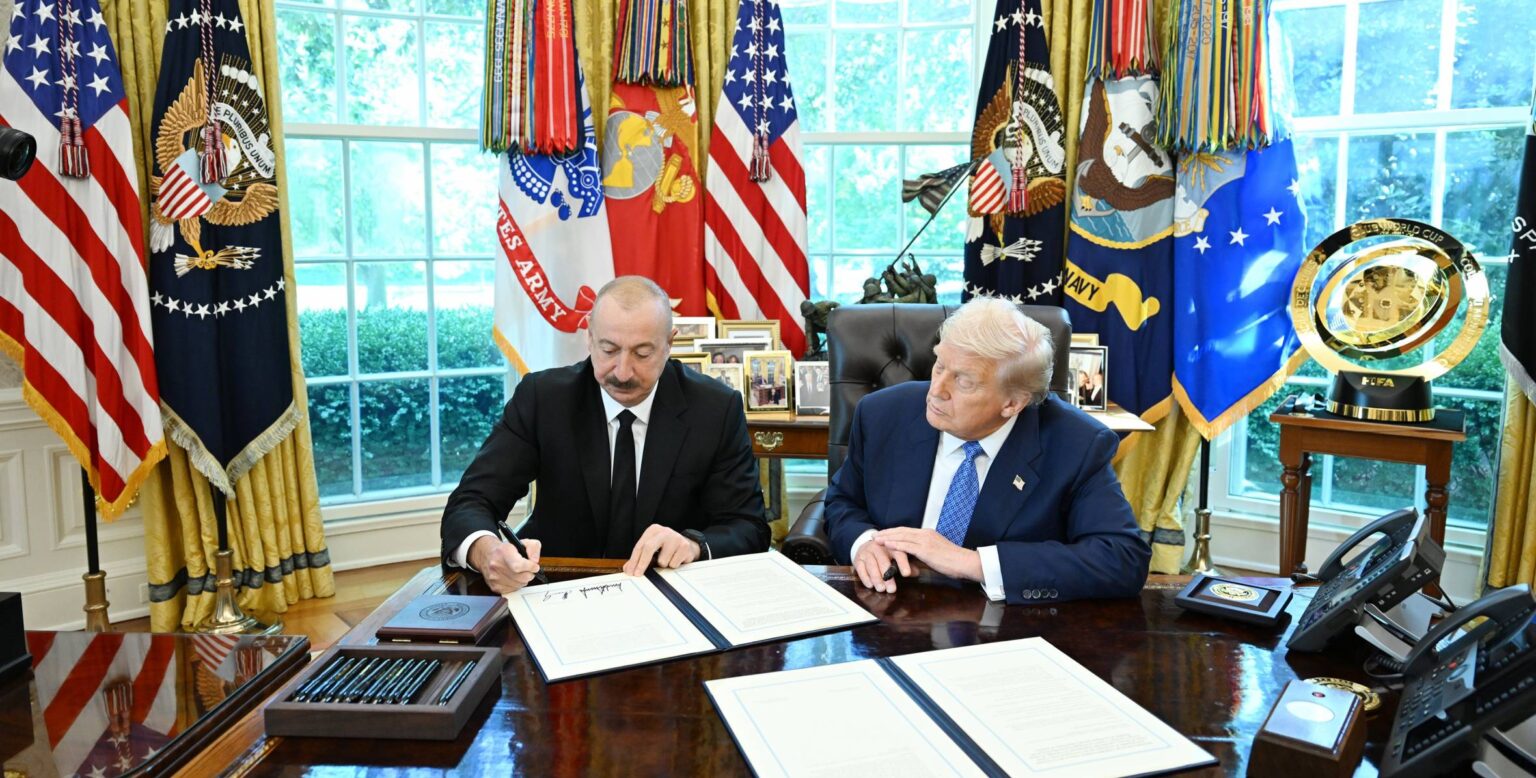
The visit of Azerbaijani President Ilham Aliyev to Washington, at the invitation of U.S. President Donald Trump, can without exaggeration be described as historic. It marked a new stage in Azerbaijan–U.S. relations and a turning point in the long-standing peace process with Armenia. The agenda focused on two core objectives: strengthening the bilateral strategic partnership with the United States and consolidating the terms of a peace settlement with Armenia.
Well before the U.S. presidential elections, Aliyev demonstrated political foresight. In July 2024, responding to a question about the upcoming election at the Global Media Forum in Shusha, he offered a positive assessment of Donald Trump — a signal of readiness to deepen cooperation should Trump return to the White House.
Following Trump’s victory, bilateral relations advanced rapidly: personal discussions, an exchange of letters, and consultations on key areas of cooperation. The fact that Aliyev’s visit took place so soon after the new U.S. president’s inauguration underscored Azerbaijan’s priority status in Washington’s foreign policy agenda.
The centerpiece of the visit was the agreement to establish a Strategic Working Group to prepare a Strategic Partnership Charter. This format institutionalizes cooperation across three main tracks:
Regional Connectivity — energy, trade, transit, and transport corridors;
Economic Investment — including digital infrastructure and artificial intelligence projects;
Security — defense cooperation, counterterrorism, and intelligence sharing.
Equally significant was President Trump’s decision to suspend Section 907 of the 1992 Freedom Support Act, adopted under pressure from the Armenian lobby. This move removed formal restrictions on direct U.S. assistance to Azerbaijan and opened the door for major American investments — in sharp contrast to the Biden administration’s use of Section 907 as a tool of political pressure.
The Washington Peace Declaration
Aliyev’s meeting with Armenian Prime Minister Nikol Pashinyan, mediated by President Trump, concluded with the signing of a Joint Declaration enshrining Azerbaijan’s core conditions:
Abolition of the OSCE Minsk Group — a joint appeal to the OSCE Secretary General to disband the body, which failed to resolve the conflict over three decades;
Constitutional Amendments in Armenia — removal of provisions containing territorial claims against Azerbaijan;
Zangezur Corridor — Armenia’s consent to establish unimpeded land connectivity between mainland Azerbaijan and Nakhchivan under U.S. guarantees;
Initialing of the Peace Treaty — the text has been agreed, with signing expected after Armenia’s constitutional referendum in 2026.
These agreements represent Yerevan’s de facto acceptance of Baku’s proposals, long rejected in the past, and mark a substantial diplomatic victory for Azerbaijan.
From Military Victory to Diplomatic Consolidation
The roots of these achievements trace back to 2020, when Azerbaijan, in the course of the 44-day Patriotic War, liberated its occupied territories, compelling Armenia to sign an act of capitulation. In the following years, Baku consolidated control through a series of steps, including the “Revenge” operation and the September 2023 anti-terrorist operation, which restored full sovereignty.
In parallel, Aliyev advanced a peace agenda, offering Armenia “five key principles” — mutual recognition of territorial integrity, renunciation of force, border delimitation, and the opening of communications. These principles became the foundation for the peace treaty text. Attempts by external actors — from the Biden administration to French President Emmanuel Macron — to alter the framework of negotiations proved unsuccessful.
Conclusion
Ilham Aliyev’s Washington visit was the culmination of a years-long diplomatic strategy: Azerbaijan not only secured international recognition of its military gains but also obtained institutional guarantees for their permanence. Simultaneously, a new phase of strategic partnership with the United States began, marked by the lifting of restrictions and readiness for large-scale investments.
Symbolically, the key agreements were reached without Russian participation and with minimal influence from unfriendly European political centers. The documents signed in Washington reflect the acknowledgment of a new geopolitical reality in the South Caucasus — one in which Azerbaijan has firmly established itself as the leading regional actor.