

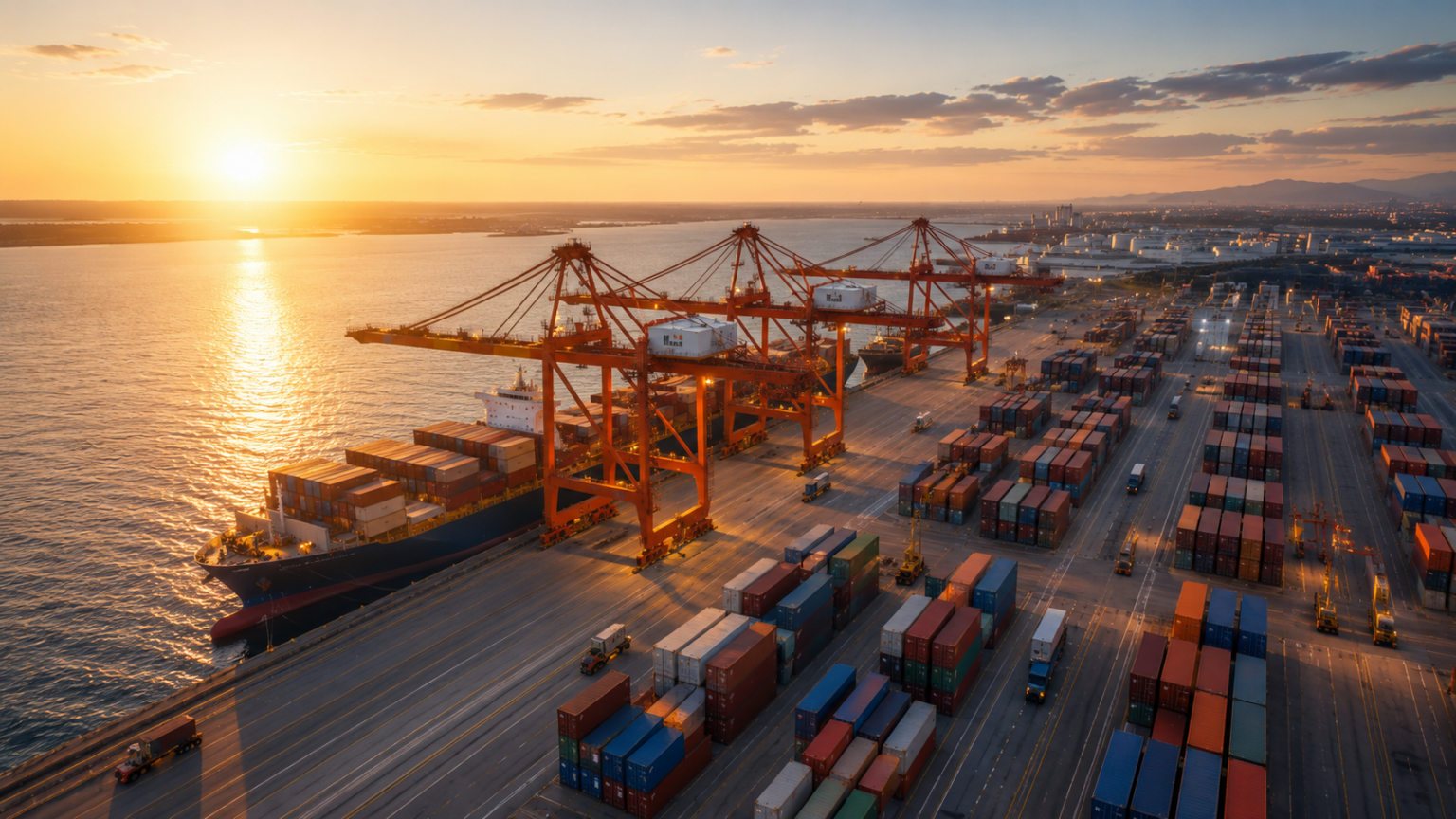
The Middle Corridor has emerged as one of the most important projects in Eurasian logistics. It connects China and Central Asia across the Caspian Sea with Azerbaijan, Georgia, Türkiye and European markets, offering an alternative to the Northern Corridor through Russia and the southern route through Iran. For Azerbaijan, it is far more than a transport link. The corridor gives the country an opportunity to convert its geographical position into transit revenues, investment and political influence.
Yet the project contains a serious contradiction. The Middle Corridor is intended to diversify Eurasian connectivity, but a substantial share of the cargo for which its infrastructure is being developed originates in China. Chinese companies are also becoming involved in financing, constructing and operating logistics facilities. As the route expands, reducing dependence on Russian and Iranian communications may therefore create a new form of dependence—this time on Beijing.
The Middle Corridor cannot fulfil its potential without Chinese participation. China remains the main source of container traffic at the eastern end of the route, while its industrial base can generate the volumes needed to make ports and railways commercially viable. Azerbaijan has every reason to encourage more China–Europe container trains, attract Chinese manufacturers to the Alat Free Economic Zone and expand bilateral trade. Artificially restricting such cooperation would run counter to the country’s economic interests.
Participation, however, is not the same as dominance. The problem begins when companies associated with one state simultaneously generate cargo flows, provide financing, win construction tenders, supply equipment, install digital systems and acquire operational responsibilities. The infrastructure may formally remain the property of the host country, while its actual functioning becomes increasingly dependent on a single source of capital, technology and commercial demand.
Chinese infrastructure corporations possess advantages that private Western companies often find difficult to match. As the OECD notes in its analysis of Belt and Road financing, Chinese development banks, the Silk Road Fund and major state-owned commercial banks have been among the principal sources of financing for BRI projects. Access to low-cost capital, state guarantees and political backing enables Chinese companies to offer terms that may be unavailable to their European or American competitors.
This is not simply a matter of offering the lowest price. Chinese corporations are often able to provide a complete package combining financing, design, construction, equipment, digital management systems and subsequent operation. For the contracting state, this can appear highly attractive: instead of negotiating separately with banks, builders, suppliers and operators, it receives a single partner capable of delivering the entire project.
The comprehensiveness of that offer, however, may itself create long-term dependence. When equipment, software, maintenance and terminal operations are tied to one corporate network, replacing the original partner becomes both difficult and expensive. A commercial advantage during the construction phase can therefore translate into reduced flexibility once the facility becomes operational. The World Bank’s assessment of Belt and Road transport corridors similarly stresses the importance of transparency, debt sustainability, open procurement and safeguards against environmental, social and corruption risks.
The history of Georgia’s Anaklia Deep Sea Port offers a revealing example. The port is intended to provide the Middle Corridor with an additional gateway to the Black Sea. The original project was developed by the Anaklia Development Consortium, established by Georgia’s TBC Holding and the US-based Conti International. In 2017, the consortium appointed the American company SSA Marine to invest in and operate the container terminal. (SSA Marine agreement)
The Georgian government terminated its agreement with the original consortium in 2020. After the project was relaunched, one of the finalists was Terminal Investment Limited, a Swiss-Luxembourg company associated with Mediterranean Shipping Company. TIL ultimately did not submit a final proposal. The only completed bid came from a Chinese-Singaporean consortium involving China Communications Construction Company, China Harbor Investment, China Road and Bridge Corporation and Qingdao Port International. (Civil Georgia)
The prospect of a Chinese state-linked conglomerate gaining a major role in the project caused concern in the United States. In April 2025, members of the bipartisan US Helsinki Commission warned that the arrangement could deepen Georgia’s dependence on China and increase Beijing’s capacity for economic pressure in the Black Sea region. This was a political assessment by American lawmakers rather than established evidence of China’s intentions, but it demonstrated the geopolitical significance attached to Anaklia. (US Helsinki Commission)
The reaction was not driven solely by competition between American and Chinese businesses. Anaklia is expected to become a strategic node connecting Central Asia, the Caspian Sea, Azerbaijan and the Black Sea. Participation in the operation of such a port entails more than commercial profit. It can provide access to cargo-flow data, influence over terminal development and a lasting presence within one of the region’s most important transport hubs.
The situation changed on 6 July 2026, when the Georgian government announced that Anaklia would be developed under the landlord-port model. The state will retain ownership and management of the core maritime and port infrastructure, while international investors and private operators will be able to develop individual container and bulk-cargo terminals. The Georgian authorities explicitly stated that the model would allow the port to work with several countries and companies rather than relying on a single partner. (Ministry of Economy and Sustainable Development of Georgia)
It would therefore be inaccurate to claim that the Chinese consortium has already secured control of Anaklia. The negotiations did not produce a final agreement, and Georgia abandoned the model based on one dominant foreign investor. Tbilisi has not excluded Chinese participation: it continues to welcome investment from China, Central Asia and Azerbaijan while preserving the leading role of the state in the development of strategic infrastructure.
This experience has direct relevance for Azerbaijan, where Chinese participation in Alat is already acquiring an institutional form. On 12 November 2024, the Port of Baku, Kazakhstan Railways and China’s Xi’an Free Trade Port Construction and Operation signed an agreement establishing a joint venture to construct an intermodal cargo terminal on an initial area of 40 hectares. The project is intended to expand the port’s handling capacity and support the growth of China–Europe container traffic. (Azerbaijan Investment Holding)
The project is consistent with Azerbaijan’s economic interests. It can increase the port’s capacity, attract additional cargo and consolidate the country’s position in trans-Caspian logistics. The Alat Free Economic Zone also has good reason to attract Chinese manufacturers capable of creating jobs and using Azerbaijan as a production and distribution base for access to the markets of Türkiye and Europe.
This effort is being pursued systematically. On 12 March 2026, the Alat Free Economic Zone Authority, with the support of Azerbaijan’s embassy and in cooperation with the China Overseas Development Association, organised an investment event in Beijing attended by more than 200 representatives of Chinese industrial and investment companies. (Alat Free Economic Zone)
The expansion of Chinese participation is not inherently a threat. The problem would arise if Chinese entities gradually secured positions across several interconnected areas: cargo generation, terminal construction, equipment supply, industrial production, digital management and facility operation. A single terminal or joint venture does not create critical dependence. The risk emerges from the cumulative effect of numerous agreements, each of which may appear commercially rational when considered in isolation.
For a transit state, such concentration can have tangible consequences. Dependence on one principal source of cargo weakens its position in negotiations over tariffs and operating conditions. Technological dependence reduces its ability to replace contractors. Reliance on a foreign provider for digital infrastructure also creates security concerns, since modern ports process commercially and strategically sensitive data concerning cargo, customers, routes, delivery schedules and customs procedures.
The investment dimension is equally important. If Western companies begin to regard Alat and other Middle Corridor hubs as zones of predominant influence for Chinese state-backed corporations, their willingness to participate may diminish. This is a potential risk rather than an established decision by Western investors, but it corresponds to a broader shift in European thinking. The European Commission’s 2026 EU Ports Strategy treats ports as critical elements of strategic autonomy and supply-chain security and calls for guidance on foreign ownership and control of strategically important port infrastructure.
This could also affect Europe’s broader assessment of the Middle Corridor. The route is attractive to Western governments because it diversifies Eurasian connectivity and reduces dependence on Russia and Iran. A corridor subject to predominant Chinese influence, however, would no longer be regarded as a fully independent strategic alternative. Under such circumstances, arguments could re-emerge in European political and business circles in favour of maintaining the Northern Corridor despite its Russian risks, or of eventually developing the southern route through Iran if international conditions change.
This risk should not be exaggerated. There is currently no confirmed decision by European governments to abandon the Middle Corridor because of Chinese involvement. The issue is how the debate may evolve. Azerbaijan has an interest in preventing such doubts from taking root rather than responding only after major investment decisions have already been made.
Western participation in the Middle Corridor therefore serves Azerbaijan’s own interests. Its purpose should not be to transform the route into an anti-Chinese project, but to preserve competition among external partners. European, American and Swiss companies can contribute technology, insurance instruments, management standards and direct access to global logistics networks.
One potential partner is Mediterranean Shipping Company. MSC is headquartered in Geneva and is one of the world’s leading container-shipping and logistics companies. Terminal Investment Limited, established as MSC’s terminal subsidiary, invests in, develops and manages container terminals in multiple regions.
The participation of MSC or Terminal Investment Limited could broaden Alat’s links to international shipping networks. No confirmed agreement currently grants either company a terminal, equity stake or operational role in Alat, however. It should therefore be presented as a possible avenue of cooperation rather than an existing arrangement.
Nor should Chinese predominance simply be replaced with a monopoly held by one Western company. A more resilient model would involve several independent operators from Europe, Türkiye, the Gulf states, Central Asia and other regions managing different terminals and logistics services.
The port’s core infrastructure should remain under state control. This includes berths, railway access, principal logistics areas and critical digital systems. Foreign companies may construct and operate individual facilities, but no single company should control the entire container chain.
Azerbaijan should also avoid a model under which one participant finances the project, constructs it, supplies the equipment, installs the software and subsequently operates the facility. Separating these functions among several companies reduces dependence and preserves the state’s ability to change partners.
Price should not be the sole criterion in procurement. Tender evaluations must also consider the origin of financing, possible state subsidies, long-term costs, cybersecurity, maintenance conditions and the compatibility of equipment with systems supplied by other manufacturers. The cheapest bid during the construction phase may not be the most advantageous over the full life cycle of the project.
Coordination among Azerbaijan, Kazakhstan, Georgia and Türkiye is equally important. The Middle Corridor is a single transport chain, and the autonomy of one section cannot guarantee the resilience of the entire route. If a strategically important port or terminal in another participating country falls under the exclusive influence of one external power, the consequences will be felt throughout the corridor.
The Middle Corridor must not depend exclusively on Chinese exports to Europe. Its long-term resilience requires greater trade among Central Asia, Azerbaijan, Türkiye and European states. Manufacturing, processing, assembly, insurance and logistics services should also be developed along the route. This would allow the participating countries to capture a larger share of the added value rather than merely collecting transit fees.
Azerbaijan does not need a policy of containing China. Beijing remains an important economic partner, a source of investment and the principal generator of cargo at the eastern end of the route. The scale of Chinese involvement, however, must be assessed in terms of the cumulative impact of all projects rather than the merits of each individual agreement.
Baku’s objective should be to use the opportunities offered by China without allowing China to become indispensable. The Middle Corridor must remain an international transport system, while its strategic hubs remain under the control of the states through whose territories it passes.
Such a model is fully consistent with Azerbaijan’s multi-vector foreign policy. Multi-vectorism does not mean maintaining equal distance from every major power. It means preserving freedom of choice and ensuring that no external partner acquires the ability to determine the rules governing the entire system.