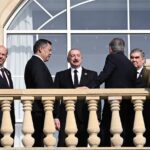


On May 16, 2025, the Albanian capital of Tirana is hosting the sixth summit of the European Political Community (EPC). According to media reports, Azerbaijani President Ilham Aliyev and Turkish President Recep Tayyip Erdoğan are attending the forum, along with Armenian Prime Minister Nikol Pashinyan.
The EPC, originally proposed by French President Emmanuel Macron, was intended as an informal platform to enhance pan-European dialogue. Yet, from its inaugural summit in Prague in October 2022, the format has become a venue for critical interactions between Armenia and Azerbaijan, including meetings brokered by European Council President Charles Michel and President Macron. At the Prague summit, both sides reaffirmed their commitment to the principles of the UN Charter and the 1991 Alma-Ata Declaration—a step many interpreted as mutual recognition of territorial integrity. Nevertheless, domestic issues in Armenia, such as constitutional amendments and the legacy of the OSCE Minsk Group, remained unresolved.
One concrete outcome of the Prague meeting was an agreement to deploy a temporary EU monitoring mission along the Armenian side of the border. President Aliyev did not consent to the mission’s presence on Azerbaijani territory but did not oppose the limited deployment on the Armenian side. However, this arrangement was later expanded beyond its original scope, raising concerns in Baku.
Shortly after Prague, bilateral relations between Azerbaijan and France began to deteriorate. A televised statement by President Macron, viewed in Baku as unduly critical, further strained diplomatic ties.
Around the same time, a trilateral meeting in Sochi involving Russia yielded little progress. With no shared agenda and growing divergences, Moscow’s traditional approach to conflict resolution appeared increasingly outdated. Azerbaijan’s reaffirmation of the Alma-Ata principles effectively signaled a pivot away from third-party mediation and toward direct bilateral engagement.
Later that year, a scheduled summit in Brussels was derailed by Armenia’s insistence that Macron participate—an ultimatum that disrupted the established format, where only Charles Michel had been accepted by Baku as a neutral mediator.
The EPC summit in Moldova in June 2023 brought together leaders from Armenia and Azerbaijan once more, with Michel, Macron, and German Chancellor Olaf Scholz also present. However, as before, Azerbaijan did not view these meetings as formal negotiations. For Baku, only the Brussels (EU-led) and Sochi (Russia-led) tracks were considered legitimate negotiation formats. Interactions within the EPC framework were treated as informal consultations—not structured dialogue.
This diplomatic approach was reaffirmed in the lead-up to the EPC summit in Granada in autumn 2023. Following the exclusion of Turkish President Erdoğan from the invite list, President Aliyev declined to attend. As a result, discussions on the future of Karabakh proceeded without one of the principal parties.
Against this backdrop, two key developments must be emphasized. First, the expansion of the Brussels format and the breach of agreed terms regarding the EU monitoring mission led Azerbaijan to reassess its trust in external mediation. Second, Baku’s consistent stance—particularly during the Sochi meeting—enabled a shift toward direct bilateral engagement. This culminated in several landmark events in 2023: the establishment of an Azerbaijani border checkpoint on the Lachin road (April 23), local anti-terror operations in September, and the eventual withdrawal of the illegal armed group in Karabakh.
By the time of the sixth EPC summit in Tirana, Azerbaijan’s foreign policy position had notably strengthened. The national flag now flies over Khankendi, reconstruction is underway in Karabakh and East Zangezur, and the return of displaced persons is actively progressing. These transformations are being closely followed not only by regional observers but by the broader international community.
Baku’s intensified diplomatic engagement—reflected in President Aliyev’s recent visits to China and Vietnam, the visit of the Iranian President to Baku, and the trip of EU High Representative for Foreign Affairs and Security Policy Kaja Kallas—signals growing recognition of Azerbaijan’s strategic role, both East and West.
For years, Azerbaijan has consistently positioned itself as a bridge between East and West. Today, this role is no longer aspirational but anchored in political reality. The country demonstrates the ability to pursue autonomous decision-making, engage effectively in diplomacy, and realize its national objectives. Azerbaijan’s participation in the Tirana EPC summit is not merely symbolic—it is an affirmation of a confident, results-driven foreign policy trajectory.