

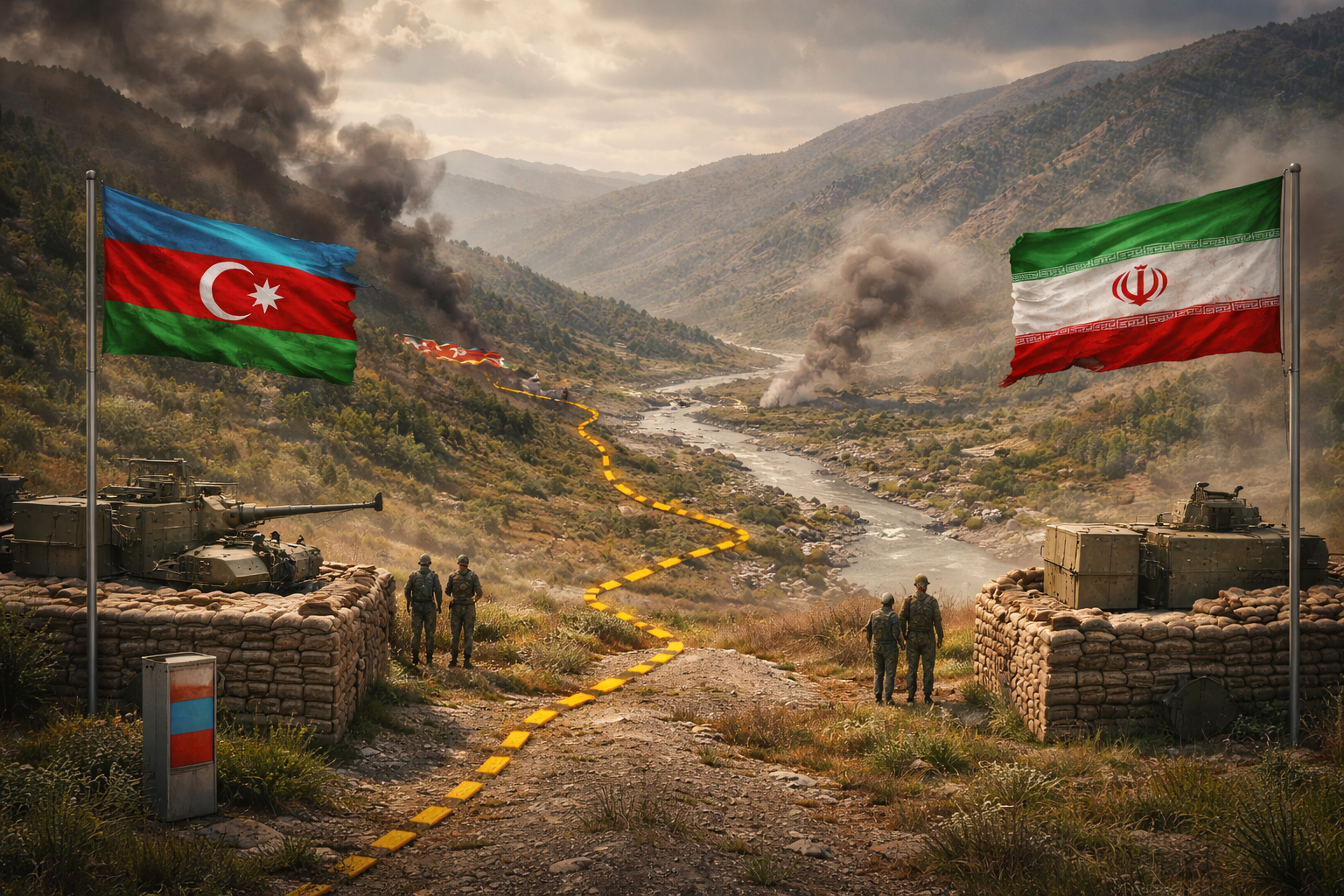
The growing military tension surrounding Iran is gradually moving beyond the framework of an internal crisis and acquiring a distinctly regional dimension. The recent incident involving drones directed toward the Nakhchivan Autonomous Republic demonstrated how quickly instability within a large state can transform into a security threat for neighboring countries.
Baku reacted promptly: President Ilham Aliyev convened a meeting of the National Security Council and instructed the country’s security agencies to take the necessary measures to ensure territorial security. The Ministry of Defense, the State Border Service, and other elements of the security apparatus were placed on heightened alert. At the same time, Azerbaijan expects official explanations from Tehran regarding the incident.
The very nature of the episode once again highlighted the fragility of the region’s security architecture. The South Caucasus and the Middle East are closely interconnected both politically and geographically, meaning that crises in one part of this system inevitably affect the other. The Nakhchivan Autonomous Republic occupies a particularly unique position within this configuration. The region has no direct land connection with the main territory of Azerbaijan, and its key communications rely largely on air links. For this reason, the security of infrastructure in Nakhchivan carries strategic importance.
In this context, recent developments once again draw attention to one of the most debated policy decisions of recent years — the preservation of Azerbaijan’s closed land borders. Initially introduced during the global pandemic as a public health measure, the policy gradually evolved into part of a broader security framework. The evolution of the regional environment has demonstrated that this approach was based on much deeper strategic considerations.
Over the past several years, Azerbaijan has found itself in an increasingly complex geopolitical environment. Military conflicts, political crises, and instability across various parts of the Middle East and neighboring regions have significantly increased the level of uncertainty. Under such conditions, control over land borders becomes one of the key instruments for preventing potential security threats.
The country’s leadership has repeatedly emphasized that restricting land crossings has helped reduce several risks. President Ilham Aliyev has noted that the measure played an important role in safeguarding national security. According to him, even with closed borders, security agencies periodically detect and prevent actions that could potentially threaten internal stability.
The situation surrounding Iran only reinforces the relevance of such a policy. Major military escalations almost inevitably generate cross-border risks. These include not only irregular migration flows but also the possible movement of radical groups, criminal networks, or sabotage elements that may exploit chaotic conditions to infiltrate neighboring states.
The South Caucasus has long been an area of heightened interest for various international actors. During periods of regional crisis, the likelihood of intensified intelligence activities, destabilization attempts, and geopolitical maneuvering inevitably increases. Open borders in such circumstances could significantly facilitate such activities.
Moreover, large-scale conflicts almost always trigger significant population movements. If Azerbaijan’s land borders were fully open, the country could face serious migration pressure. Such a scenario would inevitably place additional strain on infrastructure, social services, and the national security system.
For Azerbaijan — which in recent years has been implementing major economic and infrastructure projects — the factor of internal stability is of fundamental importance. The development of transport corridors, energy routes, and investment projects is directly linked to the level of stability within the country.
For this reason, Azerbaijan’s state strategy increasingly emphasizes preventive security policies. The logic behind this approach is not merely responding to crises once they occur, but creating conditions in which potential threats are minimized at an early stage.
At a time when new conflicts continue to emerge in different parts of the world, such a strategy is gaining particular relevance. The developments of recent years have shown that the decision to maintain closed land borders was not a temporary crisis response, but rather part of a long-term approach aimed at protecting national stability.