

On December 22, U.S. President Donald Trump announced via his Truth Social platform that he had held phone talks with the presidents of Kazakhstan and Uzbekistan, Kassym-Jomart Tokayev and Shavkat Mirziyoyev, and had invited both leaders to take part in the G20 summit next year in Miami. The very fact of these contacts and the chosen format of a public signal were perceived as a marker of a qualitative shift in Washington’s approach to Central Asia and as an attempt to move dialogue with the region beyond the confines of routine diplomacy.
Although Kazakhstan and Uzbekistan are not formal members of the G20, the practice of inviting non-member countries has long been used as a tool for expanding the political field and consolidating elements of strategic partnership. In this case, the invitation is read as recognition of Central Asia’s growing role in global economic and political processes and as an effort to integrate the region into a broader decision-making framework.
The American side reported that the key topics of the talks included the settlement of ongoing international conflicts as well as prospects for deepening trade and economic cooperation. In Astana, the conversation was described as lengthy and substantive, with particular emphasis placed on the implementation of agreements reached during Tokayev’s visit to Washington and within the “Central Asia–U.S.” format. This emphasis reflects Kazakhstan’s intention to translate political signals into concrete mechanisms and practical outcomes.
Tokayev’s position on the conflict in Ukraine deserves special attention. His statements about the complexity of a settlement, the dominant importance of the territorial dimension, and the inevitability of compromises dictated by the real situation “on the ground” fit into a line of pragmatic and cautious diplomacy. Kazakhstan consistently presents itself as a responsible middle power interested in risk reduction and in maintaining channels of dialogue among key centers of power.
The talks with the president of Uzbekistan focused on deepening the strategic partnership and advancing joint economic initiatives. In this context, references to the U.S.-Uzbekistan Business and Investment Council and to work on establishing a joint investment fund point to a shift toward institutionalized forms of interaction and an orientation toward long-term projects that go beyond political declarations.
The development of the interregional dimension of cooperation is also noteworthy: delegations from Uzbek regions continue direct contacts with individual U.S. states, thereby complementing the federal level of bilateral relations with a network of horizontal ties. This approach increases the resilience of the partnership and helps fill it with concrete economic substance. Trump’s invitations to visit Uzbekistan and Kazakhstan, voiced during the talks, were described as potentially historic, given that a sitting U.S. president has never visited Central Asia.
The broader context of these contacts points to heightened U.S. attention to the region following Trump’s return to power. Central Asia is increasingly viewed by Washington as a potential source of critically important mineral resources amid intensifying competition in high-tech sectors and transnational production chains. The growing interest in the region is largely linked to export restrictions imposed by China, which holds a dominant position in the rare earth metals market.
Under these conditions, engagement with Kazakhstan and Uzbekistan takes on a pronounced geoeconomic dimension for the United States. This is not only about diversifying raw material supplies, but also about integrating Central Asia into broader technological and logistical chains, which simultaneously raises the region’s foreign policy significance and expands the room for maneuver of its states.
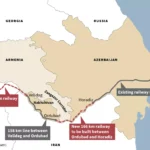
It is also important how these processes are perceived beyond Central Asia itself. In the South Caucasus, there is a growing belief that deepening U.S.–Central Asian partnership could have a noticeable impact on the implementation of the TRIPP project. In Armenian expert circles, the possibility of opening the route as early as 2026 is being discussed, while statements by Prime Minister Nikol Pashinyan about readiness to begin construction of the railway line in the Meghri section in the second half of next year add further political momentum to these assessments.
The factor of Azerbaijan also deserves special attention. President Ilham Aliyev’s initiative to integrate the country into the Central Asian cooperation format could give emerging processes a more complete and systemic character. Linking the transport and trade contours of Central Asia and the South Caucasus strengthens the latter’s role as a key transit hub along the East–West axis.
As a result, the emerging “Central Asia–South Caucasus–Europe” linkage is gradually taking on the features not merely of an economic corridor, but of a more complex spatial configuration marked by growing elements of strategic interdependence and political interaction. In this context, phone contacts and diplomatic signals that at first glance appear limited to the U.S.–Central Asian agenda begin to function as a structural factor influencing multi-regional integration processes and shaping a new logic of interregional interaction, in which regional actors themselves increasingly assert their role as independent centers of decision-making.