

In recent years, Azerbaijan’s economic policy has increasingly focused on reducing dependence on the hydrocarbon sector and building a more sustainable model of growth. In this context, the development of non-oil exports is no longer viewed merely as a supplementary economic priority, but as one of the key components of the country’s long-term economic security. This approach involves expanding the production base, supporting the private sector, increasing foreign currency revenues and gradually strengthening the position of Azerbaijani products in external markets.
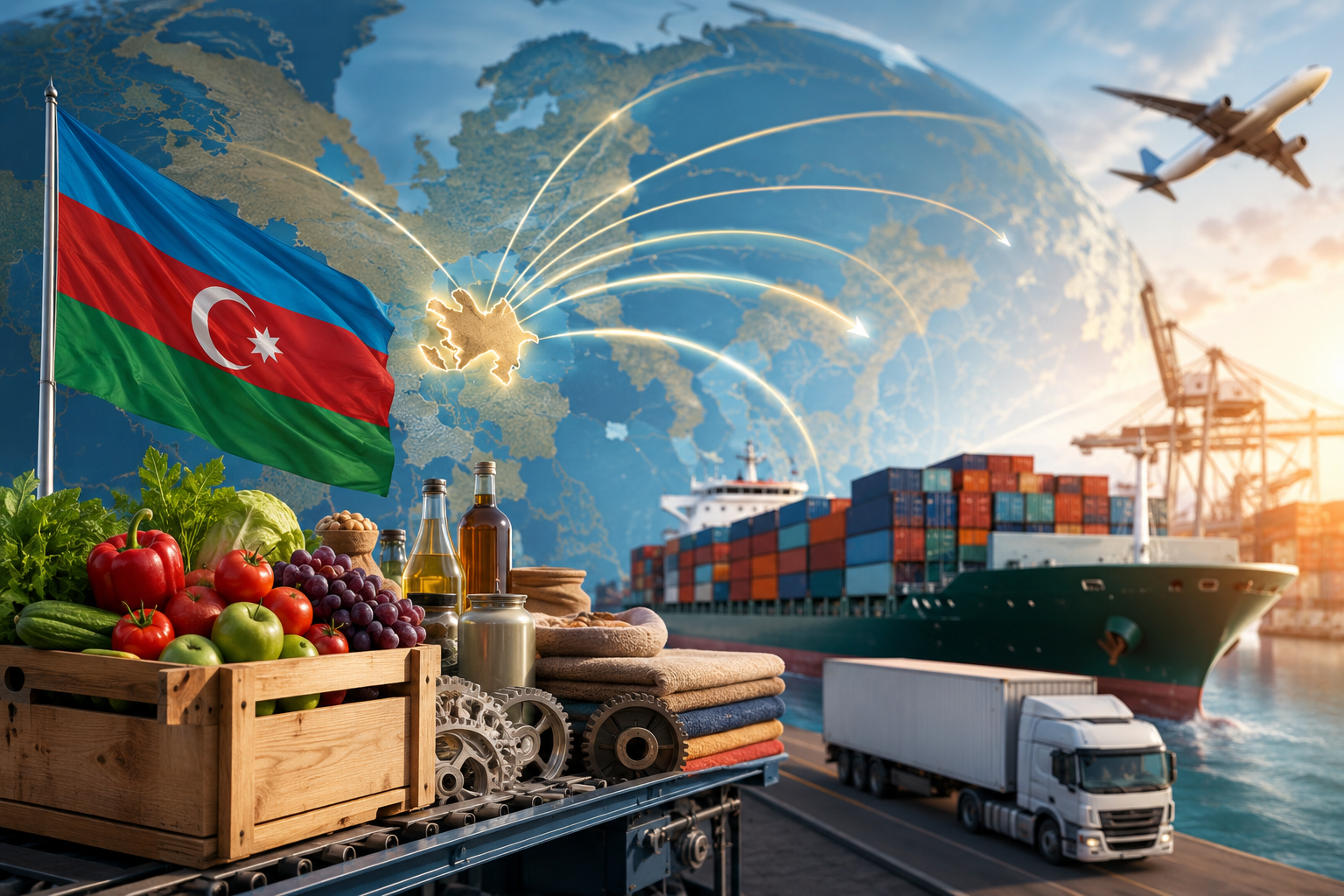
It is within this broader logic that the decree signed on June 9 by President Ilham Aliyev on additional measures to stimulate the export of non-oil and non-gas products and compensate transport costs should be understood. At first glance, the document may appear to be a technical measure aimed at supporting specific categories of producers. In reality, however, its significance is much broader. The state is effectively moving toward a more flexible export policy model, one that focuses not only on production and market promotion, but also on one of the most sensitive factors of competitiveness: the cost of logistics.
For Azerbaijan, this issue is of fundamental importance. The country has already made visible progress in developing non-oil sectors. Production capacities are expanding in agriculture, the food industry, the chemical sector, construction materials and a number of other areas. Yet production growth alone does not automatically guarantee successful access to new markets. Between the producer and the final buyer lies an entire chain of costs, and the transport component within this chain often becomes decisive.
Azerbaijani producers may offer high-quality and competitive products, but when supplies are directed toward more distant markets, the final price rises because of transportation costs. As a result, goods with genuine export potential may lose out to foreign competitors not because of weaknesses in production, but because of the cost of delivery. This is especially relevant for markets beyond traditional export destinations, where logistics require additional spending, more complex routing and greater financial resilience on the part of exporters.
In this context, partial compensation of transport costs becomes more than a form of business support. It is a tool for adjusting market conditions. The state is assuming part of the costs that objectively limit the export activity of companies. In doing so, it creates opportunities for Azerbaijani products to reach a wider range of foreign markets, including those that previously may have seemed commercially risky or insufficiently profitable.
This mechanism could be particularly beneficial for producers of agricultural goods, food products, construction materials, chemical products and other categories of goods in which logistics account for a significant share of the final price. For these sectors, even a partial reduction in transport costs may allow companies to offer more attractive terms to foreign partners, increase supply volumes and expand the geography of exports.
It is also important to note that such policies are not unusual in international practice. Many states seeking to strengthen the position of their companies in global markets use export support instruments, including assistance with transportation costs, participation in international exhibitions, marketing promotion and subsidies for entry into new regions. One of the most prominent examples is Türkiye, which has for many years developed an active system of support for exporters, particularly those entering markets in Africa, Asia and Latin America. This approach allows companies to reduce initial risks and gain a foothold in markets where competing without state support would be considerably more difficult.
In Azerbaijan’s case, the new mechanism also has another important dimension: support for the Nakhchivan Autonomous Republic. Despite the geopolitical changes that followed the Second Karabakh War, Nakhchivan remains territorially separated from the main part of Azerbaijan. This creates objective transport and economic constraints for local producers. Their products face additional logistics costs even before reaching the national or international market.
The planned compensation of costs for transporting goods produced in Nakhchivan to the main territory of Azerbaijan is aimed at softening this imbalance. In essence, the state seeks to create more equal conditions for businesses in the autonomous republic and reduce the impact of geographic separation on the competitiveness of local enterprises. This is particularly important for integrating Nakhchivan more deeply into the country’s overall economic system and expanding its production potential.
International parallels are also clear in this regard. Various forms of transport cost compensation are applied to remote, northern, island or geographically isolated regions, from Alaska in the United States and the northern territories of Canada to island regions of the European Union and certain remote areas of China. The Azerbaijani approach, however, is distinctive in that it combines two strategic objectives at once: stimulating non-oil exports and reducing the economic costs associated with Nakhchivan’s specific geographic position.
From this perspective, the new decree should be seen not as a one-off measure, but as part of a broader strategy. Azerbaijan is seeking to remove one of the systemic barriers limiting the development of the non-oil sector. Amid instability in global markets, growing geopolitical competition and periodic disruptions to international supply chains, the ability of a country to develop alternative sources of export revenue is becoming increasingly important. The more diversified the export structure, the lower the economy’s vulnerability to fluctuations in energy prices.
At the same time, the state is sending an important signal to business. Exporters are being encouraged to think beyond familiar and nearby markets and to consider a broader geography of supply. For many companies, transport costs are precisely the factor that prevents them from entering new destinations. If part of these costs is compensated, entrepreneurs will be able to test new markets more actively, establish ties with foreign partners and gradually expand their presence abroad.
Of course, the effectiveness of the new mechanism will depend on its practical implementation. Transparency of criteria, the speed of application review, predictability of payments and accessibility for different categories of producers will all be crucial. If the mechanism operates flexibly and without excessive bureaucracy, it could become a significant factor in the growth of non-oil exports. If the procedure proves too complicated, its impact will be limited.
Nevertheless, the logic behind the decision deserves attention. Azerbaijan’s economic policy is increasingly moving from general production support toward more targeted work on specific barriers that prevent businesses from competing in external markets. In this case, logistics has been identified as such a barrier. This means that the state is beginning to view exports not simply as the final outcome of production policy, but as a complex system in which infrastructure, transport corridors, delivery costs, market access and the ability of companies to withstand international competition all matter.
This is why the decree on the compensation of transport costs carries not only economic but also strategic significance. It reflects an attempt to change the behavior of exporters, broaden the horizons of Azerbaijani business and strengthen the role of the non-oil sector in the national economy. The practical results of this policy will become clear over time. Yet it is already possible to say that the state is taking a step toward a more active, pragmatic and competitive export model.