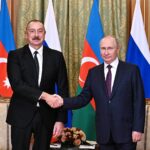


On December 24, President of Azerbaijan Ilham Aliyev turns 64. He has led the country since 2003, making him one of the longest-serving leaders in the post-Soviet space. His period in office has coincided with a phase of profound transformation in Azerbaijan — from a post-Soviet state with limited sovereignty to an independent regional actor with its own political and economic priorities.
The model of succession implemented in the early 2000s became the first such arrangement in the post-Soviet space to preserve institutional continuity and avoid systemic upheaval. It ensured political stability, predictability in domestic and foreign policy, and created conditions for long-term strategic planning. In this respect, Azerbaijan differed from a number of neighboring states where elite change was accompanied by crises, institutional weakening, and loss of governability.
A key turning point during Ilham Aliyev’s presidency was the Second Karabakh War of 2020, followed by the 2023 counterterrorism operation in Khankendi and adjacent areas. These events brought an end to the long-running conflict linked to Armenia’s occupation of part of Azerbaijan’s territory and terminated the existence of separatist structures in Upper Karabakh. For the first time since the early nineteenth century, the practice of external exploitation of the “Armenian factor” as an instrument of pressure on Baku and revision of the regional status quo was effectively dismantled.
The military and political outcome of these processes led to the restoration of Azerbaijan’s territorial integrity and altered the balance of power in the South Caucasus. One significant consequence was the return of Zangezur to the practical political agenda and the issue of transport connectivity between mainland Azerbaijan and the Nakhchivan Autonomous Republic. The concept of the Zangezur Corridor, previously perceived as a historical and political abstraction, was institutionalized in regional agreements and became part of the new logistical architecture of the South Caucasus.
Domestically, the military events of 2020–2023 consolidated a societal consensus in Azerbaijan regarding the outcomes of the post-Soviet period. Victory in the war marked the conclusion of a phase that began with the collapse of the Soviet Union and opened space for the formation of a more autonomous state policy, oriented not toward managing inherited conflicts but toward development and institutional consolidation.
Alongside foreign policy and military-strategic changes, Azerbaijan began restructuring its system of public administration. In recent years, a course was set toward moving away from an oligarchic economic model and forming a governance apparatus based on technocratic principles. Partial elite rotation was carried out, oversight of the bureaucracy was strengthened, and criminal cases were initiated against public officials accused of corruption and abuse of office.
This policy was accompanied by a redistribution of powers within the executive branch and efforts to adapt state institutions to new economic and social realities. Particular attention was paid to reducing the influence of informal decision-making centers and strengthening the vertical chain of accountability.
Ideologically, Ilham Aliyev’s approach is characterized by a rejection of revolutionary scenarios and abrupt institutional ruptures. Priority is given to evolutionary change, the preservation of governability, and reliance on traditional social and political structures. In this sense, the current stage of governance can be seen as a transition from a mobilization model focused on restoring territorial integrity and implementing an oil-driven strategy to a more complex task — the formation of a resilient legal and social state.
Thus, Ilham Aliyev’s presidency has entered a new phase. While the first two decades were largely devoted to issues of sovereignty, security, and state consolidation, the current period is associated with institutional development, the social contract, and the search for a long-term development model in a post-conflict environment. The outcomes of this transformation will shape Azerbaijan’s position in the regional security system and the political economy of the South Caucasus in the medium term.