


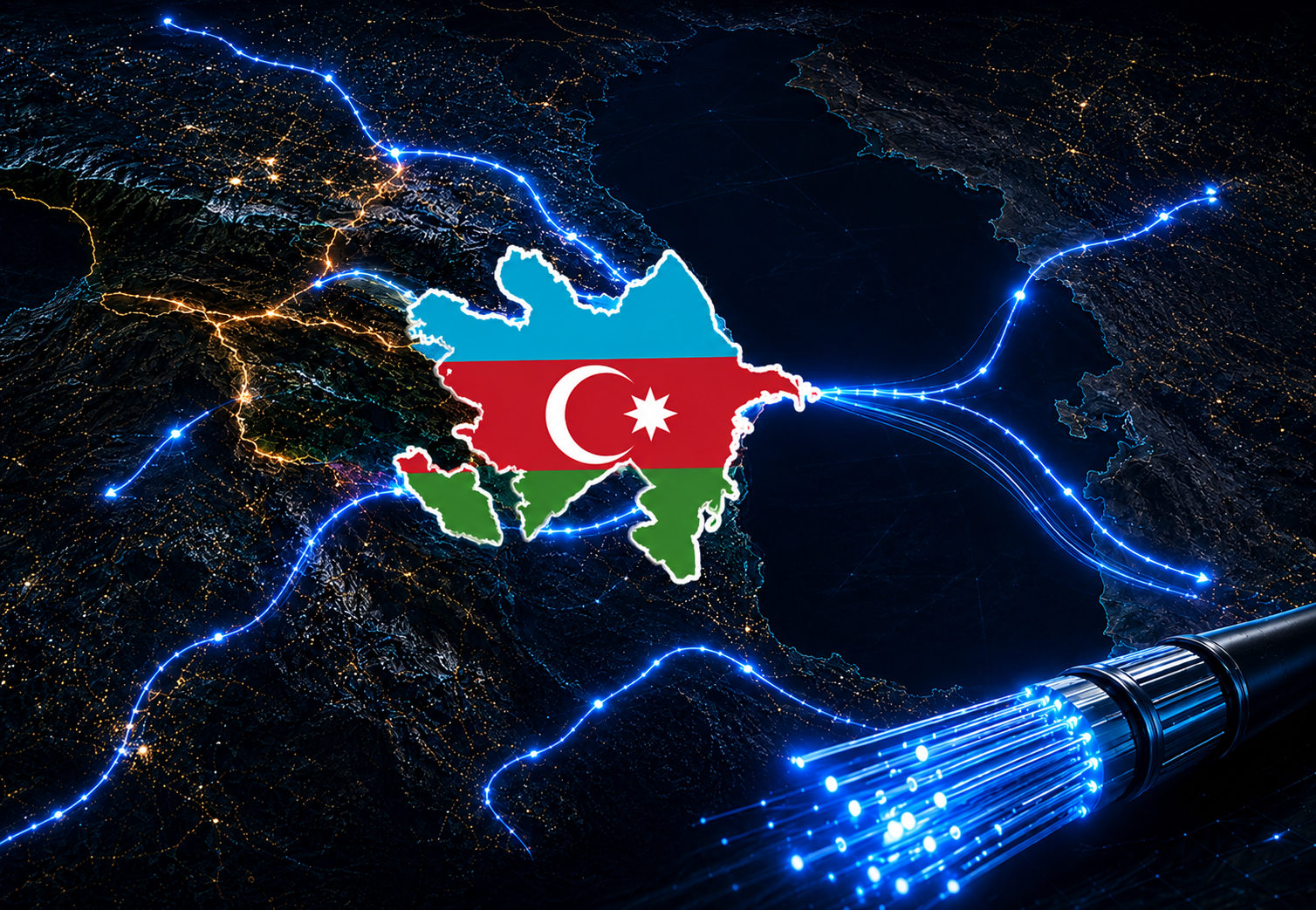
In the global politics of the 21st century, the very understanding of power is changing. If, in the industrial era, a state’s influence was determined primarily by territory, resources, ports, railways and pipelines, today another factor has been added to this list: the ability to control and protect data flows.
Azerbaijan has already established itself as a “hub state” — a country through which energy, transport and logistics routes pass between Europe and Asia. The Middle Corridor, the Southern Gas Corridor, the Trans-Caspian route, as well as railway and port infrastructure, have turned Baku into an important element of Eurasian connectivity. However, the new phase of global competition requires more. The issue is no longer only oil, gas and containers, but also internet traffic, data centers, fiber-optic lines, cloud services and cyber resilience.
This is where the transition from the logic of a “hub state” to the logic of a “network state” begins.
The modern economy depends on digital communications no less than on maritime routes or energy corridors. International payments, banking operations, cloud platforms, state databases, media, artificial intelligence and infrastructure management systems all function through global information transmission networks. Submarine cables, data centers and telecommunications corridors have become just as critical an infrastructure as oil and gas pipelines.
The crises of recent years around the Red Sea, the Suez Canal and the Middle East have shown how vulnerable this infrastructure remains. A significant share of digital communication between Europe, the Middle East, India and East Asia passes through a limited number of routes. Any military instability, act of sabotage or cable damage immediately affects connection speeds, financial operations and the stability of digital services.
That is why global demand for alternative digital routes is growing. Eurasia is once again coming into focus — but this time not only as a space of railways, ports and pipelines, but also as a territory of future land-based and transregional digital corridors. For Azerbaijan, this opens a new strategic window.
Baku is seeking to use its geographical position in the digital dimension as well. The South Caucasus and the Caspian Sea can become part of an alternative data transmission route between Europe and Asia. Fiber-optic infrastructure projects, the Digital Silk Road, the transit of internet traffic and the development of data centers allow Azerbaijan to expand its role: from an energy and transport hub to a communications hub.
The logic is clear. If the Southern Gas Corridor strengthened Azerbaijan’s importance for Europe’s energy security, digital corridors can increase its significance for the information and technological connectivity of Eurasia. In both cases, the principle is the same: the country becomes important not only in itself, but also as an infrastructural bridge between major regions.
However, digital geostrategy brings not only opportunities, but also new risks.
The deeper a state is integrated into international digital networks, the more attractive a target it becomes for cyberattacks, information operations and hybrid pressure. For Azerbaijan, this is no longer a theoretical problem. In recent years, the country has faced attacks on government websites, media resources, information systems and elements of digital infrastructure. Cyberspace has gradually become another field of regional confrontation — alongside diplomacy, the media and the military sphere.
This becomes especially sensitive against the backdrop of complicated relations with several neighboring and external actors. The Armenian-Azerbaijani conflict has long gone beyond the framework of a classical military confrontation and has affected the information and cyber domains. Tensions with Iran also increase the importance of digital security. Periods of deterioration in relations with Russia have shown that pressure on media and information infrastructure can be used as an element of broader hybrid policy.
Under these conditions, cybersecurity ceases to be a purely technical issue. It becomes part of national security, foreign policy and economic competitiveness. If a country wants to be a digital hub, it must not only transmit traffic, but also guarantee its security. It must not only build data centers, but also protect them. It must not only connect to global networks, but also preserve resilience in the event of attacks.
Here, Azerbaijan has both advantages and limitations. Its advantages include geographical location, an energy base, experience in participating in major infrastructure projects and growing ties with technologically advanced partners, including Israel, Türkiye and the countries of Central Asia. The energy factor is especially important: data centers and artificial intelligence infrastructure require enormous volumes of stable and relatively cheap electricity. Azerbaijan, possessing its own energy resources and developing projects in green energy, can use this as a competitive advantage.
But there are also serious challenges. Competition for the status of a digital hub is already underway among the UAE, Saudi Arabia, Türkiye, Kazakhstan, Israel and other players. Many of them have larger financial resources, more developed technological ecosystems and stronger global brands. For Azerbaijan, this means that geography alone is not enough. It needs human capital, institutional resilience, investment, a legislative framework, the trust of international partners and a high level of cyber protection.
A separate issue is human capital. A digital hub is impossible without specialists in cybersecurity, artificial intelligence, cloud infrastructure, big data, telecommunications and engineering. Therefore, Azerbaijan’s digital strategy must be linked not only to cables and data centers, but also to universities, technology parks, startups, IT education and the attraction of specialists.
The Turkic technological space may also become an important direction. The informal summit of the Organization of Turkic States in Turkistan, where digitalization and artificial intelligence were placed among the priorities, shows that Turkic integration is gradually acquiring a technological dimension. For Azerbaijan, this is particularly important: the country can become not only a bridge between Europe and Asia, but also a digital link between Türkiye, Central Asia, the Caucasus and European markets.
Thus, Azerbaijan is entering a new phase of its geostrategy. Previously, the key question was the country’s place on the map of energy and transport corridors. Today, this is supplemented by the question of its place on the map of digital flows. In the future, the importance of a state will be determined not only by what cargo, oil or gas passes through its territory, but also by what data, networks and technological services pass through its infrastructure.
The concepts of the “hub state” and the “network state” do not contradict each other. On the contrary, in Azerbaijan’s case, they reinforce one another. Transport routes, energy corridors, digital cables, data centers and cybersecurity are gradually forming a single strategic architecture.
If Baku manages to combine geography, energy, technology, security and human capital, Azerbaijan will be able to move from the role of a regional transit hub to the status of one of the key communications centers of the new Eurasia.

