

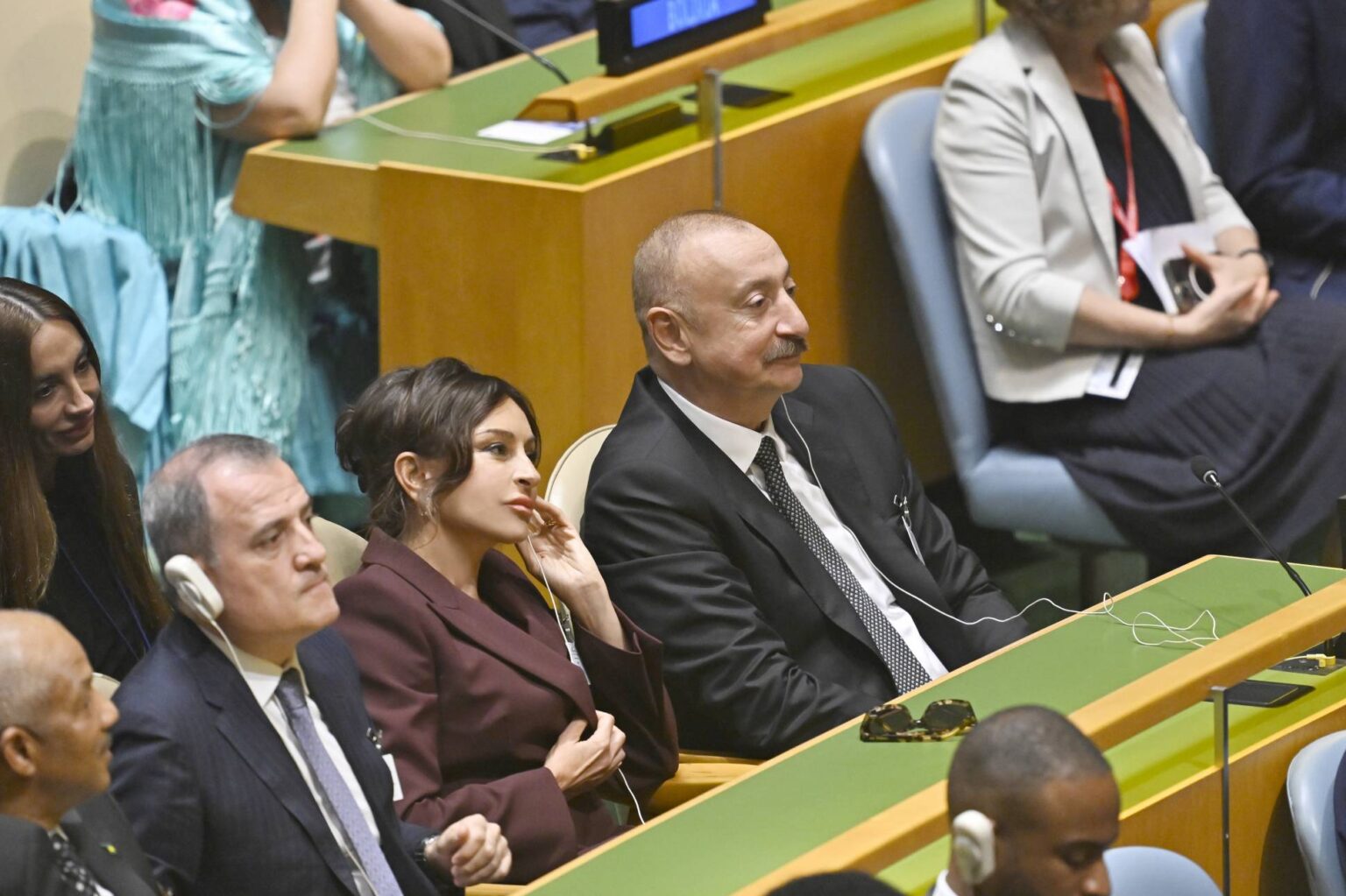
The working visit of Azerbaijani President Ilham Aliyev to the United States for the 80th anniversary session of the UN General Assembly was a telling moment in the context of Baku’s growing role in regional and international affairs. On the sidelines of the Assembly, Aliyev conducted an intensive series of meetings in which political and financial agendas were closely intertwined, underscoring that Azerbaijan today is setting the tone in regional politics.
On September 22, immediately upon arrival, a cycle of negotiations began with global capital managers — ranging from infrastructure giants to leading investment firms. For Baku, this was not simply a matter of showcasing investment attractiveness, but a demonstration of its status as a player that has strengthened its positions in energy, transit, and security after restoring territorial integrity, and that is now approached as a partner for projects and long-term capital.
The first step was a conversation with Bruce Flatt, CEO of Brookfield Asset Management, a corporation that manages one of the world’s largest portfolios of infrastructure and energy assets. This was followed by meetings with the leadership of Neuberger Berman and Blackstone. Significantly, all these encounters were initiated by the other side, reflecting the perception of Azerbaijan not only as a resource base but also as a platform for joint investments in logistics, energy, and real estate — areas that align directly with the country’s priorities of network modernization and the development of the Middle Corridor.
Equally important were the September 24 meetings with Adebayo Ogunlesi, founder of Global Infrastructure Partners, Jenny Johnson, head of Franklin Templeton, and Michael Arougheti, co-founder of Ares Management. The symbolism lay in the fact that each of these players represents a distinct segment of global capital: GIP in hard infrastructure, Franklin in public markets and debt, and Ares in private credit and hybrid instruments.
Together, these encounters shaped a comprehensive investment vector, enabling Baku to translate political weight into project-based economics and a portfolio of tangible deals. The tone of communication made it clear that international players did not come for protocol, but with genuine interest in large-scale projects.
The investment track was closely intertwined with diplomacy. On the sidelines of the General Assembly, Aliyev met with the prime ministers of Greece and Bulgaria, the presidents of Portugal and Iraq, and the secretary general of the Council of Europe. The geographic span — from the Mediterranean to the Middle East — highlighted that Azerbaijan has moved beyond a South Caucasus focus and is perceived as a key node of European energy security and East–West connectivity.
This is where the interests of electricity and gas interconnectors, port and rail logistics, and political stabilization of neighboring regions converge. For Europe, this means access to diversified energy flows; for the Middle East, it provides an entry to EU markets via the South Caucasus corridor architecture.
What emerges is a dual-track model: political legitimization and capital mobilization. Baku goes beyond declarations by advancing a concrete agenda — green energy, electricity exports, network modernization, acceleration of cargo flows along the Middle Corridor, and the integration of customs and digital solutions.
Underpinning this agenda is a financial foundation, with direct lines established to those capable of implementing large-scale investment projects. In this sense, the New York meetings were not ceremonial handshakes but a systematic strengthening of the “muscle” of project economics, where Azerbaijan is increasingly acting not as an object, but as an organizer and co-investor.
This dynamic is the outcome of a shifting balance of risks and opportunities. Following the restoration of territorial integrity, the country has demonstrated the predictability of its strategic course, the effective management of infrastructure programs, and the ability to convert geopolitics into economics.
The New York talks only reinforced this trend: Azerbaijan is being approached not out of courtesy, but because without it, building a sustainable architecture of energy and transport across the Caspian–Black Sea–Mediterranean axis is difficult.
As a result, Azerbaijan’s role in regional politics is increasingly defined not only by diplomatic weight but also by its capacity to organize capital around corridors and interconnectors. New York showed that if in the past regional agendas were built around political formulas, today they are increasingly centered on Azerbaijani projects — the clearest indicator that Baku’s authority is being converted into a long-term architecture of development.